This article is some notes while I struggled to figure out thermodynamic
minimisation. There's some good bits but a lot I'd do differently now.
Certainly this is not the approach I'd use now either, so take what is useful
and leave the rest!
Background thermodynamics
This section outlines the derivation of thermodynamics with a focus
on applied chemical thermodynamics. In short, thermodynamics is a
set of differential and algebraic constraints on state
variables. These constraints are really powerful, as they give you
relationships between real measurable (and immeasurable) properties
(the state variables). Ultimately we want to determine what will
happen to real fluids, thus in the end we focus on determining the
equilibrium state. But we're getting ahead of ourselves, lets
carefully argue everything out.
Thermodynamic systems, variables, and state
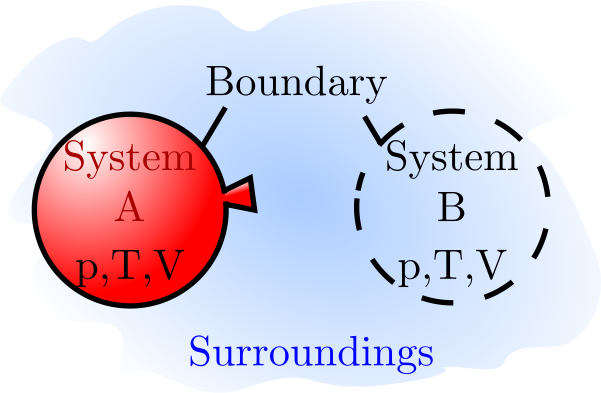
A closed balloon system (A) and an open system (B), both
exhibiting the observables of pressure, $p$, volume, $V$, and
temperature, $T$, which can be measured at (or over) its
boundary.
First, lets define some terminology. A thermodynamic system is the partitioning of
some quantity of mass and energy from its surroundings
through an enclosing boundary. The key idea is the division
of what we are interested in (the system) from the uninteresting
(the surroundings).
The boundary of the system may be physical (e.g., the walls of a
vessel such as a balloon) or may be defined by some imaginary
division of space (e.g., a finite volume in a CFD simulation). If
the boundary is physical, then it may or may not be included as
part of the system. For example, water droplets in air have a
surface tension which acts like the skin of a balloon and pulls
the drop into a spherical shape. This "stretched elastic" surface has an
associated energy and it is at our discretion whether to include
the energy as part of the system or as part of the surroundings
(or neglect it entirely as an approximation).
Both physical and imaginary boundaries may be fixed or change shape
over time, we don't care about that in equilibrium thermodynamics,
only what the contents of the system is. If mass can pass through
the boundaries then the system is deemed open and closed if it
cannot.
The mass and energy contained inside a thermodynamic system may take
many forms, but only the observable properties at the
boundary of the system, such as volume, mass, surface area, and
pressure are visible to us. Thermodynamics focuses on these
observable variables and tries to find mathematical relationships
to link these variables together. Any other internal effect
the mass and energy of the system has cannot be seen unless it
appears at the boundary and so thermodynamics does not immediately
concern itself with these invisible properties. For example, a
thermometer measures the temperature at its surface/boundary with
the system it is inserted in. If the system is small enough, then
the observable properties should be approximately constant across
the system. For larger systems, we can always split it into smaller
and smaller sub-systems until the observable properties of a system
are approximately constant. Moving on, we will always assume each
system we consider is small enough (and thus homogeneous enough) to
ignore any changes in observable properties across its volume. We do
this so that we can assume all processes are reversible later to
keep us in the realm of equilibrium thermodynamics.
The sum total of the energy inside a system (the internal
energy) is not directly observable as most of it is
internally stored away from the boundary; however, the
conservation of energy tells us it must exist. It should come as
no surprise then that there are other internal variables, such as the entropy, which can
only be discerned indirectly and yet are very interesting to
thermodynamics (but more on this later).
The key external and internal variables are the
so-called state variables. These are the variables that
change whenever the system itself has changed. This is a circular
argument which is easy to understand for the external variables as
we only know if a system has changed if the observable properties
themselves have changed. Counter examples of non-state variables
are the age of the system or the distance it has moved (assuming
there's no external field like gravity to couple distance with
energy), as these non-state variables can change without anything
really happening to the system. If a complete set of state
variables is collected such that any change of the system results
in a change in one (or more) of the collected state variables then
we have what is called an ensemble. Which variables are
collected into an ensemble really depends on what we are observing
and how we are observing it. For example, perhaps our
external/observable variables are temperature and volume for a
balloon. However, we could also measure the balloon's pressure and
mass. Thermodynamics later tells us that the (molar) volume is
directly related to the pressure and temperature, so its redundant
to observe all of these variables; however, its important to
realise that all state variables are of equal importance, they are
all just observable quantities and we can calculate one from the
other once we have enough of them. As chemical engineers/chemists,
we like to talk about temperature and pressure all the time but
that does not mean that using volume/entropy/internal energy or
some free energy instead is not more valid. The mathematics does
not care. To try to "shake-off" the idea that some variables are
special, mathematicians have an "exercise" called the implicit
function theorem. Instead of writing $y=f(x)$, they write
$y-f(x)=0$ or $f'(y,\,x)=0$. This final form shows that $y$ and
$x$ are equal, either can be obtained from the other (under
certain conditions), i.e. $x=f^{-1}(y)$. A simple example of this
in thermodynamics is the ideal gas relationship,
\begin{align}\label{eq:idealgas} P\,V = N\,R\,T. \end{align}
If you've done any calculations with this you should be familiar
with rearranging this equation to make $P$, $V$, $N$, or $T$ the
subject of the equation,
\begin{align*} P &= N\,R\,T\,V^{-1} & V &= N\,R\,T\,P^{-1} \\N &=
P\,V \left(R\,T\right)^{-1} & T &= P\,V \left(N\,R\right)^{-1}.
\end{align*}
Thus its a good mental exercise to think of the ideal gas law as
$P\,V-N\,R\,T=0$ and realise that all state variables are equal in
importance.
Back to the "ensemble". The number of state variables needed to
build an ensemble really depends on the system studied. For
example, the thermodynamic system of a battery uses the same
variables as a balloon but also includes the electric potential
(and current) across its terminals as this is one way energy can
be transferred out the system. This is a key concept: an ensemble
is complete when any process connected to the transfer of mass
and/or energy in the system has its associated state
variables. These variables always come in "conjugate" pairs
(e.g. $p$ and $V$), but this is discussed more later.
Now that the initial terminology has been outlined, a governing
equation for the changes in the energy of a thermodynamic system can be
derived.
The fundamental equation
The power of thermodynamics arises from its ability to find simple
universal relationships between observable state variables. These
relationships are a direct consequence of the laws of
thermodynamics.
The first law of thermodynamics is an observation that
energy is neither created or destroyed but only transformed
between different forms. Every thermodynamic system may contain
internally some energy, $U$. The first law then allows us
immediately write $U_{sys.}+U_{surr.}=C$ where $C$ is a constant
and is the total energy of the universe but this equation is not
particularly useful. Lets look instead at how energy might be
transferred:
\begin{align}\label{eq:firstlaw} {\rm d} U_{sys.} = - {\rm
d}U_{surr.}, \end{align}
where the ${\rm d}X$ indicates an infinitesimal change in $X$.
This is called an exact differential as $U_{sys.}$ cannot
change without $U_{surr.}$ changing, thus the two variables are
always linked.
From further observation of real systems, two different types of
energy transfer are identified: heat transfer and "work",
\begin{align}\label{eq:initialebalance} {\rm d} U_{sys.} = - {\rm
d}U_{surr.} = \partial Q_{surr.\to {sys.}} - \partial W_{sys.\to
surr.}, \end{align}
where $\partial Q_{surr.\to {sys.}}$, is heat transferred to the
system due to temperature differences and $\partial W_{sys.\to
surr.}$ represents all forms of work carried out by the system
(the negative sign on the work term is a conventional choice). The
work term represents many forms of energy transfer, so why is heat
transfer singled out? Well, it appears that Nature wants to
maximise heat transfer over work whenever possible, and we'll get
back to this later when reversibility is introduced.
Engines cycle back to their initial starting state, and
thus are designed to perform arbitrary amounts of work without
changing their state. Of course, this ignores wear and tear of the
engine.
You should note that a $\partial$ symbol is used for the
work/heat-transfer terms to indicate inexact differential
relationships. A thermodynamic system may transfer arbitrarily large
amounts of heat, and perform arbitrarily large amounts of work, but
only the remainder $(\partial Q_{\to {sys.}}-\partial W_{sys.\to surr.})$
will actually cause a change in the energy $U_{sys.}$.
The internal energy is a state variable as it describes the
state of the system; however, work and heat transfer are not.
A physical example which illustrates this include engines, which
are thermodynamic systems that can perform arbitrary amounts of
work provided sufficient heat/energy is supplied but they return
to their initial state at the end of every cycle. An inexact
differential implies there is no unique relationship between the
variables (we cannot integrate this equation). Interestingly,
inexact differentials can often be transformed into simpler exact differentials
through the use of constraints. For example, if the engine is seized
and no work can be carried out ($\partial W_{sys.\to surr.}=0$),
then only heat transfer can change the energy of the system and we
now have an exact differential relationship, ${\rm d}U_{sys.}={\rm
d}Q_{\to {sys.}}$. This constraint is far too restrictive in general
and another constraint, known as reversibility, must be invoked to
generate exact differential equations we can integrate.
In the next two subsections, the concept of reversibility is
introduced through consideration of cycles and is used to find exact
differential descriptions of work and heat.
Cycles, reversibility, and heat
A thermodynamic cycle is a process applied to a
thermodynamic system which causes its state (and its state
variables) to change but eventually return to its initial state (and
so it also returns to the initial values of its state
variables). For example, the combustion chamber inside an engine
will compress and expand during its operation but it returns to its
starting volume after each cycle. This leads to the following
identity where the sum/integral of the changes over a cycle are
zero, i.e., $\oint_{\rm cycle} {\rm d} V=0$, and similar identites
must also apply for every state variable.
In 1855, Clausius observed that the integral of the heat transfer
rate over the temperature is always negative when measured over a
cycle,
\begin{align*} \oint_{\rm cycle} \frac{\partial Q_{surr.\to
{sys.}}}{T_{sys.}}\le0. \end{align*}
This is known as the Clausius inequality. It was found that this
inequality approaches zero in the limit that the cycle is
performed slowly. This limiting result indicates that the kernel
of the integral actually contains a state variable, i.e.,
\begin{align}\label{eq:entropydefinition} {\rm d} S_{sys.} &=
\frac{\partial Q_{surr.\to {sys.}}}{T_{sys.}}; & \text{(assuming slow internal changes)}, \end{align}
where $S_{sys.}$ is the state variable known as entropy of
the system. Interestingly, the entropy (like the internal energy) is
not directly observable and its existence is only revealed by this
inequality.
As the inequality is generally negative over a cycle, it indicates
that entropy always increases and must be removed from a system to
allow it to return to its initial state (except in the limit of slow
changes). This has led to the terminology of
the irreversible cycle, $\oint_{\rm cycle}{\rm d}S>0$, and
the idealised reversible cycle, $\oint_{\rm cycle}{\rm
d}S=0$, which can be returned to its starting state without removing
entropy.
If the Clausius inequality is true, the total entropy
of a isolated system can only increase over time. Assuming the
universe is an isolated system (at least over the timescales we're
interested in), our thermodynamic system and its surroundings must
always together have a positive (or zero) entropy change.
One last thing to note, thermodynamic processes which are not
cycles may also be reversible or irreversible. For a general
process to be reversible the total entropy change of the system
and its surroundings together must remain zero. This allows the
entropy to increase or decrease in the system, but only if the
surroundings have a compensating opposite change. Let's now
introduce the various forms of work for comparison.
Work
Both popping a balloon (left) and releasing it untied
(right) results in the same final state (air outside the balloon);
however, releasing the air slowly through the neck allows work to
be extracted causing the balloon to fly around.
The work term $\partial W_{sys.\to surr.}$ represents all methods of
transferring of energy other than as heat. Reversible paths reduce
total entropy changes to zero, which minimizes the heat transferred
and actually maximizes the amount of work performed by the system
for a given process. It also turns work into an exact differential!
As an illustrative example, consider the emptying of a balloon via
popping it versus untying the neck and letting it go. In the first
case, no work is done as the air is immediately released into the
surroundings: this is the quickest path of deflating the balloon
thus it maximizes entropy. Untying the neck, the air jet leaving the
balloon will perform work by propelling the balloon around the room
(thus yielding kinetic energy). This slower release of air has
allowed work to be extracted.
All work can be expressed as a generalized driving force,
$\vec{F}_{sys.}$, which is displaced by a change in the
corresponding generalized distance, $\vec{L}_{sys.}$. For the
balloon, the force is the pressure difference in the neck (and the
air resistance, which should be equal and opposite when the system
is reversible) and the distance is the travel of the balloon. The
reversible limit corresponds to infinitesimally slow/small changes
of the distance (i.e., ${\rm d}\vec{L}$) allowing all opposing
forces time to remain in balance resulting in the following general
expression for the work.
\begin{align*}
{\rm d}W_{sys.} &= \sum \vec{F}_{sys.}\cdot {\rm d}\vec{L}_{sys.} & \text{(assuming reversibility)}.
\end{align*}
For the balloon, there are three forms of work taking place. First,
as the volume of the balloon is decreased work must be performed to
compress the volume against the pressure of the air within. The
reversible pressure-volume work is then as follows,
\begin{align}\label{eq:pressurevolumework}
{\rm d} W_{{sys.},pV} = p_{sys.}\,{\rm d}V_{sys.},
\end{align}
where the pressure $p$ is the generalised force and the volume $V$
is the generalised displacement. In addition, the balloon itself is
shrinking, releasing the tension within its elastic surface. This is
known as surface work,
\begin{align}\label{eq:surfacework}
{\rm d} W_{{sys.},surface} = \gamma_{sys.}\,{\rm d}\Sigma_{sys.},
\end{align}
where $\gamma_{sys.}$ is the surface tension and $\Sigma_{sys.}$ is the surface
area.
As air leaves the balloon through the neck it will carry away energy
with it. This is known as chemical work,
\begin{align}\label{eq:materialwork}
{\rm d} W_{{sys.},mass} = -\sum_i^{N_C} \mu_{i,{sys.}}\,{\rm d} N_{i,{sys.}},
\end{align}
where the chemical potential, $\mu_{i,{sys.}}$, is the energy added
to the system if one mole of the component $i$ (from one of the
$N_C$ components of the system) is added to or removed from the
system by any process (e.g., flow through the boundaries or internal
reactions). The definition of a component, $i$, in a thermodynamic
system is flexible and may be used to represent a single type of
atom, molecule, or elementary particle (i.e., electrons), or even a
mixture of molecules (such as "air").
The term ${\rm d} N_{i,{sys.}}$ represents changes in the amounts of
a species $i$. This change may be due to mass flowing in or out of a
system, but it may also result from reactions within a system;
However, for closed system (a system which cannot exchange
mass with any other system), chemical work is impossible and thus
the conservation of energy requires that the following holds true
(even if ${\rm d} N_{i,{sys.}}\neq 0$ due to internal processes such
as reactions),
\begin{align*}
\sum_i^{N_C} \mu_{i,{sys.}}\,{\rm d} N_{i,{sys.}} &= 0 & \text{for closed systems}.
\end{align*}
Closed systems are typical during process/unit-operation
calculations; however, as these closed systems are often composed of
multiple open sub-systems (i.e. multiple interacting phases within
a closed vessel) the chemical work term is always useful to retain.
Summary of the fundamental equation
In summary, under the constraint of a reversible system, the
expression for entropy (Eq. \eqref{eq:entropydefinition}) and
any relevant work terms (Eq. \eqref{eq:pressurevolumework}-\eqref{eq:materialwork}) can be substituted
into
the energy balance
of Eq. \eqref{eq:initialebalance}, to yield the fundamental
thermodynamic equation,
\begin{align}\label{eq:fundamentalThermoRelation}
{\rm d} U &= T\,{\rm d}S -p\,{\rm d}V +\sum_i^{N_C} \mu_{i}\,{\rm d} N_{i}+\cdots,
\end{align}
where the subscripts have been dropped from every term for
convenience. Other work terms, such as the surface or electrical
work, can be added to this equation depending on the system studied;
however, the pressure-volume and chemical work terms are the most
important from a process engineering perspective.
Solution of the fundamental equation
As we have an exact differential in
Eq.\eqref{eq:fundamentalThermoRelation} if the internal energy is
taken as function of $U(S,\,V,\,\left\{N_i\right\})$, then the total
derivative of the internal energy in these variables is as follows,
\begin{align*}
{\rm d}U= \left(\frac{\partial U}{\partial S}\right)_{V,\left\{N_j\right\},\cdots}{\rm d}S +
\left(\frac{\partial U}{\partial V}\right)_{S,\left\{N_j\right\},\cdots}{\rm d}V +
\sum_i^{N_C}\left(\frac{\partial U}{\partial N_i}\right)_{S,V,\left\{N_{j\neq i}\right\},\cdots}{\rm d}
N_{i}+\cdots.
\end{align*}
where, for clarity, the variables which are held constant while a
partial derivative is taken are written as subscripts on the
parenthesis surrounding the derivative (this is needed for clarity
as in thermodynamics we often change the set of independent and
dependent variables).
Comparing the total derivative above to the fundamental
thermodynamic relation of Eq.\eqref{eq:fundamentalThermoRelation}
yields the following definitions of the partial derivatives,
\begin{align*}
\left(\frac{\partial U}{\partial S}\right)_{V,\left\{N_{j}\right\},\cdots}&= T
&
\left(\frac{\partial U}{\partial V}\right)_{S,\left\{N_j\right\},\cdots}&=-p
&
\left(\frac{\partial U}{\partial N_i}\right)_{S,V,\left\{N_{j\neq i}\right\},\cdots}&=\mu_i.
\end{align*}
This is the first indication that thermodynamics is a powerful tool
as it has already found a differential relationship between the
internal energy and the intensive properties. Also, as the variables
of $U(S,\,V,\,\left\{N_i\right\})$, are all extensive, Euler's
solution for homogeneous functions applies.
Proof of solution for homogeneous functions
Consider some function (in our case an extensive thermodynamic
property), $Z$. Assume that the property is only a function of the
extensive quantities $\left\{{sys.}_i\right\}$ (these may be the molar
amounts $\left\{N_i\right\}$, volume $V$, and entropy $S$ which
are all extensive). If all of the extensive properties
$\left\{A_i\right\}$ are scaled equally by some factor, $k$, the
extensive thermodynamic property must also scale. Thus,
\begin{align*}
Z\left(\left\{k\,A_{i}\right\}\right) = k\,Z\left(\left\{A_{i}\right\}\right),
\end{align*}
where $k$ is some arbitrary scaling factor. $Z$ is therefore a
homogeneous
function of first order in $\left\{A_i\right\}$. Taking the
derivative of both sides with respect to $k$ (chain rule on the
LHS):
\begin{align*}
\frac{\partial \left\{k\,A_{i}\right\}}{\partial k}\cdot\frac{\partial}{\partial
\left\{k\,A_{i}\right\}}Z\left(\left\{k\,A_{i}\right\}\right) = \frac{\partial }{\partial k}
k\,Z\left(\left\{A_{i}\right\}\right)\\
\left\{A_{i}\right\}\cdot\frac{\partial}{\partial
\left\{k\,A_{i}\right\}}Z\left(\left\{k\,A_{i}\right\}\right) = Z\left(\left\{A_{i}\right\}\right)
\end{align*}
At this point it is selected that $k=1$ and expanding the dot
product as a sum,
\begin{align*}
Z\left(\left\{A_{i}\right\}\right) = \sum_{i}A_{i} \frac{\partial Z}{\partial A_{i}}
\end{align*}
This allows us to solve for $Z$ if the partial derivatives in
terms of each of its extensive parameters are known.
This allows the equation to be "solved" immediately as it is a
first-order homogeneous function of the extensive properties.
\begin{align}\label{eq:intEnergy}
U= T\,S - p\,V + \sum_i^{N_C}\mu_i\,N_i+\cdots.
\end{align}
This is the remarkably simple solution for the internal energy which
is the first
thermodynamic potential we encounter.
Natural variables
When performing calculations in thermodynamics, we are free to
specify our system state using any of the state variables introduced
so far
$(U,\,T,\,S,\,p,\,V,\,\left\{\mu_i\right\}^{N_C},\,\left\{N_i\right\}^{N_C})$,
but how many are required and which ones are independent? Each term
of the fundamental thermodynamic equation consists of a
so-called conjugate pairing of an intensive
property such as $T$, $p$, or $\mu_i$ and a corresponding
conjugate extensive property $S$, $V$, or
$\left\{N_i\right\}$ respectively. Provided all the relevant work
terms have been included, it has been observed that a thermodynamic
state is fully specified if at least one variable is
specified for each of the conjugate pairs considered.
The natural variables for a particular function are
whichever choices result in an exact differential relationship for
that function. For example, the internal energy has the natural
variables $U(S,\,V,\,\left\{N_i\right\}, \ldots)$. This is apparent
from Eq.\eqref{eq:fundamentalThermoRelation}, where these variables
are all exact differentials related to ${\rm d}U$. Unfortunately,
these variables are not particularly nice (and the internal energy
is not particularly interesting) as we cannot directly measure the
entropy or internal energy in experiments. There are other
thermodynamic potentials which have more convenient natural
variables and these can be derived by considering the consequences
of the second law of thermodynamics. These are all Legendre
transforms of the internal energy thus their natural variables will
always correspond to one variable from each conjugate pair.
Free-energies and thermodynamic potentials
The second law of thermodynamics has already been introduced via the
Clausius inequality and is formally written as follows,
\begin{align*}
{\rm d} S_{total} \ge 0,
\end{align*}
i.e., the total entropy of the universe (our system and its
surroundings) must always increase or remain constant. This
statement implies that the only "stationary" thermodynamic state is
where the entropy has reached its maximum, henceforth known as
the equilibrium state. The equilibrium state is of
particular interest as all thermodynamic systems approach it and, if
left undisturbed, remain there indefinitely.
It is often the basis of process calculations that a particular
thermodynamic system has reached equilibrium, thus determining
the equilibrium state (via a maximization of the total entropy) is
our primary goal. Starting from some initial non-equilibrium state,
some unconstrained internal parameters (e.g., composition, reaction
progression) are varied such that the total entropy is maximized.
Although the universe's entropy must be maximized at equilibrium,
our interest is in a smaller thermodynamic system contained within
it. The total entropy is the sum of the entropy of this system
within the universe and the rest of the universe, i.e.,
\begin{align*}
S_{total}&=S_{sys.}+S_{surr.}.
\end{align*}
It is clear that both $S_{sys.}$ and $S_{surr.}$ may increase or
decrease, provided the overall change results in an increase of
$S_{total}$.
It is henceforth assumed that the surroundings are at equilibrium,
they remain at equilibrium, and any interaction with the
surroundings is reversible. The author considers these the largest
assumptions they have ever made, both physically and in terms of
approximation; however, it is equivalent to a “worst
case” estimate for the generation of entropy. In this case,
there can be no “external” process driving changes
within the thermodynamic system. Anything that the system does must
happen “spontaneously”. In this case, the only possible
mechanism by which the universe's entropy may change is via heat
transfer from the system (and the heat flux becomes an exact differential).
\begin{align*}
{\rm d} S_{total}&={\rm d} S_{sys.}+{\rm d} S_{surr.}\\
&={\rm d} S_{sys.}+\frac{{\rm d} Q_{sys.\to surr.}}{T_{surr.}}\\
&={\rm d} S_{sys.}-\frac{{\rm d} Q_{surr.\to sys.}}{T_{surr.}}.
\end{align*}
This makes it clear that the entropy change of the system must be
balanced against the entropy it is generating in the surroundings
through heat transfer (the surroundings are also so large the other
effects of the heat transfer are negligble). Inserting the
fundamental thermodynamic equation
(Eq.\eqref{eq:fundamentalThermoRelation}),
\begin{align}
{\rm d} S_{total}&={\rm d} S_{sys.}-\frac{{\rm d}
U_{sys.} + p_{sys.}\,{\rm d}V_{sys.} - \sum_i^{N_C}
\mu_{i,sys}\,{\rm d} N_{i,sys.}}{T_{surr.}}.
\end{align}
To simplify the remainder of this section, the thermodynamic system
is now assumed to be closed which allows the elimination of
the chemical potential term,
\begin{align}\label{eq:totalentropy}
-T_{surr.}\,\left({\rm d} S_{total}\right)_{C}&={\rm d} U_{sys.} + p_{sys.}\,{\rm d}V_{sys.}-T_{surr.}\,{\rm
d}
S_{sys.}.
\end{align}
The subscript $C$ on the parenthesis is used to indicate that the
system is closed. This equation makes it clear that, in closed
systems interacting reversibly with its surroundings which are at
local equilibrium, the overall equilibrium is not solely linked to
the entropy of the system itself but is the minimisation of
the RHS of Eq.\eqref{eq:totalentropy} (due to the negative sign on
the entropy change). The RHS often corresponds to
some thermodynamic potential which arise under different
constraints and these are now derived in the sections below.
Isolated system (closed system at constant volume and internal energy)
Consider a system which is completely isolated from its
surroundings. It cannot exchange heat
$\left({\partial}Q=0\right)$ or work
$\left({\partial}W=0\right)$. As we're in the zero-work
reversible limit, the system must be at constant volume
$\left({\rm d}V=0\right)$ and the molar amounts
$\left\{N_i\right\}$ may individually vary but only such that
$\left(\sum_i^{N_C} \mu_i\,{\rm d} N_{i,A}=0\right)$. Examining
the original balance in Eq.\eqref{eq:initialebalance},
\begin{align*}
{\rm d} U = \cancelto{0}{\partial Q} - \cancelto{0}{\partial W} &= 0,
\end{align*}
thus it is clear that the isolated constraint is also equivalent
to ${\rm d}V=0$ and ${\rm d}U=0$. Examining the total entropy
under these constraints,
\begin{align*}
\left({\rm d} S_{total}\right)_{U,V,C}&={\rm d} S_{sys.}+\frac{\cancelto{0}{\partial Q_{sys.\to
surr.}}}{T_{surr.}}\\
&={\rm d} S_{sys.},
\end{align*}
where the subscripts on the brackets indicate that the $U$, $V$,
are held constant in the closed system. It is clear from this
expression (and our own intuition) that an isolated system, with
surroundings already at equilibrium, all changes in the total
entropy must arise from changes in the system entropy.
To put this in terms of minimising a thermodynamic potential
we define the negative of the entropy (sometimes
called negentropy),
\begin{align*}
\left(f\right)_{U,V,C}=f_{U,V,C}=-S_{sys.}.
\end{align*}
To determine the equilibrium state the potential, $f_{U,V,C}$,
must be minimised and this action is equivalent to maximising
the total entropy.
Closed systems under constant temperature and pressure
Isolated systems are interesting in certain cases; however, in
process engineering, we often have a closed system at a fixed
temperature $T$ and pressure $p$. Under these conditions the
system is free to transfer heat and change its volume. For the
interaction of the system with its surroundings to be
reversible, the surroundings must have the same temperature
$T_{sys.}=T_{surr.}$ and pressure $p_{sys.}=p_{surr.}$.
If we now define a new thermodynamic potential called the Gibbs
free energy,
\begin{align*}
G = U + p\,V - T\,S,
\end{align*}
and look at changes in $G$ while holding $T$ and $p$ constant, we have,
\begin{align*}
\left({\rm d} G\right)_{T,p} = {\rm d} U +p\,{\rm d} V - T\,{\rm d} S
\end{align*}
Comparing with this expression against
Eq.\eqref{eq:totalentropy} it is immediately apparent that,
\begin{align*}
\left({\rm d} S_{total}\right)_{T,p,C} &= -\left(\frac{{\rm d} G_{sys.}}{T_{sys.}}\right)_{T,p,C}.
\end{align*}
Thus, maximisation of $S_{total}$ is equivalent to minimisation
of $G$ when $T$ and $p$ are held constant. Writing this in the
same notation as before we have,
\begin{align*}
f_{T,p,C} = G_{sys.}.
\end{align*}
Closed systems under constant temperature and volume
Again, reversibility requires that $T_{surr.}=T_{sys.}$. No
pressure-volume work occurs as the volume is fixed and so the
pressure of the surroundings is actually irrelevant. Material
work is also ignored as the system is closed.
\begin{align}
\left({\rm d} S_{total}\right)_{T,V,C}&=-\frac{{\rm d} U_{sys.} + p_{sys.}\,\cancelto{0}{{\rm
d}V_{sys.}}-T_{surr.}\,{\rm d} S_{sys.}}{T_{surr.}}
=-\left(\frac{{\rm d}A}{T_{sys.}}\right)_{T,V,C}.
\end{align}
In the final equality, another thermodynamic
potential is introduced: the Helmholtz free energy,
\begin{align*}
A &= U - T\,S.
\end{align*}
It is now clear that under these constraints the maximum total
entropy is reached at the minimum Helmholtz free energy. I.e.,
\begin{align*}
f_{T,V,C} = A_{sys.}.
\end{align*}
Closed system under constant pressure and enthalpy
The enthalpy is defined as follows,
\begin{align*}
H&=U+p\,V\\
{\rm d} H &= {\rm d} U+ V\,{\rm d} p + p\,{\rm d} V.
\end{align*}
For constant pressure and enthalpy we have,
\begin{align*}
\left({\rm d} U + p\,{\rm d} V\right)_{H,p} = 0.
\end{align*}
Examining the total entropy under these constraints (Eq.\eqref{eq:totalentropy}),
\begin{align}
\left({\rm d} S_{total}\right)_{H,p,C}&=-\frac{\cancelto{0}{{\rm d} U_{sys.} + p_{sys.}\,{\rm
d}V_{sys.}}-T_{surr.}\,{\rm d} S_{sys.}}{T_{surr.}}
={\rm d} S_{sys.}.
\end{align}
Even though the surroundings temperature is unknown, it is
merely a scaling factor and again the maximisation of the
total entropy is equivalent to the minimisation of the
system's negentropy,
\begin{align*}f_{H,p,C} = -S_{sys.}.\end{align*}
Closed system under constant entropy and pressure
Again, starting with the total entropy of a closed system, Eq.\eqref{eq:totalentropy},
\begin{align}
\left({\rm d} S_{total}\right)_{p,S,C}&=-\frac{{\rm d} U_{sys.} + p_{sys.}\,{\rm
d}V_{sys.}-T_{surr.}\,\cancelto{0}{{\rm d} S_{sys.}}}{T_{surr.}}.
\end{align}
We note that,
\begin{align*}
\left({\rm d} H\right)_{p} &= {\rm d} U+ \cancelto{0}{V\,{\rm d} p} + p\,{\rm d} V
\end{align*}
Thus, we have
\begin{align*}
\left({\rm d} S_{total}\right)_{p,S,C} &= -\left(\frac{{\rm d}H}{T_{surr.}}\right)_{p,S,C}.
\end{align*}
The surroundings can be at some arbitrary constant temperature
(they are at equilibrium and very large thus unaffected by heat
transfer), thus $T_{surr.}$ is simply a scaling factor. The
thermodynamic potential to minimise is then $f_{p,S,C} = H_{sys.}$.
Closed system under constant entropy and volume
Finally, the simplest example,
\begin{align}
\left({\rm d} S_{total}\right)_{p,S,C}&=-\frac{{\rm d} U_{sys.} + p_{sys.}\,\cancelto{0}{{\rm
d}V_{sys.}}-T_{surr.}\,\cancelto{0}{{\rm d} S_{sys.}}}{T_{surr.}} = \frac{{\rm d}
U_{sys.}}{T_{surr.}}.
\end{align}
Thus, the thermodynamic potential to minimise for maximum total
entropy is $f_{S,V,C} = U_{sys.}$ and the surroundings
temperature is unimportant.
Summary
In summary, there are a number of relevant thermodynamic potentials
for a closed system. These are defined below,
\begin{align}
U&= T\,S - p\,V + \sum_i^{N_C}\mu_i\,N_i\label{eq:Urule}\\
H&= U + p\,V = T\,S + \sum_i^{N_C}\mu_i\,N_i\label{eq:Hrule}\\
A&= U - T\,S = - p\,V + \sum_i^{N_C}\mu_i\,N_i\label{eq:Arule}\\
G&= H - T\,S = \sum_i^{N_C}\mu_i\,N_i\label{eq:Grule}
\end{align}
For each set of constrained thermodynamic states in closed
systems, a particular thermodynamic potential is minimised at
equilibrium. These are summarised in the table below:
Constants
Function to minimise, $f$
$p,\,S$
$H$
$p,\,T$
$G$
$p,\,H$
$-S$
$V,\,S$
$U$
$V,\,T$
$A$
$V,\,U$
$-S$
The variables held constant correspond to the "natural" variables of
each potential. Expressing the change in each thermodynamic
potential in terms of these natural variables yields the following
differential equations,
\begin{align}\label{eq:dU} {\rm d}U &= T\,{\rm d}S - p\,{\rm d}V +
\sum_i^{N_C}\mu_{i}\,{\rm d} N_{i}\\ -{\rm d}S &= -\frac{1}{T}{\rm
d}U - \frac{p}{T}{\rm d}V + \sum_i^{N_C}\frac{\mu_{i}}{T}\,{\rm d}
N_{i}\\ {\rm d}A &= -S\,{\rm d}T - p\,{\rm d}V +
\sum_i^{N_C}\mu_{i}\,{\rm d} N_{i}\label{eq:dA}\\ {\rm d}H &=
T\,{\rm d}S + V\,{\rm d}p + \sum_i^{N_C}\mu_{i}\,{\rm d} N_{i}\\
{\rm d}G &= -S\,{\rm d}T + V\,{\rm d}p + \sum_i^{N_C}\mu_{i}\,{\rm
d} N_{i}.\label{eq:dG} \end{align}
The significance of the chemical potential cannot be overstated. It
is the change of each thermodynamic potential per mole of each
species exchanged when the other natural variables of the potential
are held constant,
\begin{align}\label{eq:ChemPotDefinition} \mu_i =
-T\left(\frac{\partial S}{\partial N_i}\right)_{U,V,\left\{N_{j\neq
i}\right\}}= \left(\frac{\partial A}{\partial
N_i}\right)_{T,V,\left\{N_{j\neq i}\right\}} = \left(\frac{\partial
H}{\partial N_i}\right)_{S,p,\left\{N_{j\neq i}\right\}} =
\left(\frac{\partial G}{\partial N_i}\right)_{T,p,\left\{N_{j\neq
i}\right\}} \end{align}
The implication of this is that when dealing with systems exchanging
mass, but constrained by two "natural" variables, the chemical
potential for each species must be equal in all phases, regardless
of which constrained variables are actually used (otherwise a change
of mass between systems could change the value of the overall
thermodynamic potential implying it is not at a minimum). It is
also the partial molar Gibbs free energy ($G=\sum_i N_i\,\mu_i$) and
thus calculation of the Gibbs free energy can be reduced to
considering the chemical potential.
The thermodynamic potential, $f$, to be minimised
depending on the variables chosen to be constant.
Constants
Function to minimise, $f$
$p,\,S$
$H$
$p,\,T$
$G$
$p,\,H$
$-S$
$V,\,S$
$U$
$V,\,T$
$A$
$V,\,U$
$-S$
Minimisation details
This section deals with the computational problem of implementing a
general thermodynamic potential minimiser. Unless you are doing
this, you probably want to skip this chapter and go straight to the models.
The previous section established that
finding equilibrium means finding the minimum of a thermodynamic
potential, $f$. Which potential depends on which variables are held
constant (see the table). This section digs into the minimisation
itself to understand the approach, what thermodynamic properties are
needed to actually perform it, and any gotchas.
Thermodynamic potential minimisation
To be as general as possible, we're going to consider a closed
system (our universe) containing $N_p$ thermodynamic
sub-systems. Each subsystem $\alpha$ is typically a different phase
with $N_{C,\,\alpha}$ components within it and is described by a
set of state variables
$\vec{X}_\alpha=\left\{\left\{N_{i,\alpha}\right\}^{N_{C,\,\alpha}},\,T_\alpha,\,p_\alpha\text{
or }\,V_\alpha\right\}$ where either the pressure $p_\alpha$ or the
volume $V_\alpha$ is used depending on the thermodynamic model of
the subsystem/phase. The state vector of our "universe" is then generated by
collecting all of these variables together, i.e.,
$\vec{X}=\left\{\vec{X}_\alpha\right\}^{N_P}$.
Our aim is to determine the equilibrium state, $\vec{X}_{equil.}$,
of the universe under some conditions. Mathematically the
minimisation can be expressed as follows,
\begin{align*}
f\left(\vec{X}_{equil.}\right)&=\min_{\vec{X}}\left(f\left(\vec{X}\right)\right)
& &\\ \vec{X} &\ge \vec{0} & &\\ g_k\left(\vec{X}\right) &= 0 &
k&\in[1,N_{constraints}], \end{align*}
Lets discuss each line in turn. The first line simply says the
equilibrium value of the potential is found at the minimium of the
potential. The second line is a non-negativity constraint to keep
the minimisation in a physical region, i.e.
\begin{align}\label{eq:nonNegConstraints}
\left\{\left\{N_{i,\alpha}\right\}^{N_{C,\,\alpha}},\,T_\alpha,p_\alpha\text{
or }\,V_\alpha\right\}^{N_P} &\ge 0, \end{align}
This is needed as without it the minimiser will dumbly react away
unstable compounds until their amounts turn negative, and keep going
as it continues to lower the thermodynamic potential, $f$.
Some other implementations must allow electron amounts to go
negative (i.e. to allow positive ions to form), but SimCem tracks
the total electron count in the system allowing a non-negative
constraint to be applied even in this case.
Finally, there are a number of additional equality
constraints which we write in general as follows,
\begin{align}
g_k\left(\vec{X}\right) &= 0,
\end{align}
where $k$ is the index of an equality constraint which holds some
function of the state variables, $g_k\left(\vec{X}\right)$, to a
value of zero. One example of these are the material
constraints arising from mass/mole balances (e.g. conservation of
elements) whereas the other constraints arise from constraints on
thermodynamic variables (e.g., constant enthalpy and
pressure). Before these are discussed, we review how constrained
minimisation is carried out in general to better understand how
these constraints are combined with the minimisation problem.
Lagrange multipliers
Computerised minimisation routines simply repeatedly change the
value of the state variable and track the state with the lowest
value of the thermodynamic potential. The only difference between
various algorithms is how intelligently the system selects the new
values of the state variables to try.
In this simple approach, its easy to implement the non-negativity
constraints on the state variables
(Eq.\eqref{eq:nonNegConstraints}).
Whenever the computer attempts to changes the state variables to
below zero it is prevented from doing so in a method called called
bounds checking. The equality constraints embodied by $g_k$ may be
highly non-linear and thus its not easy to immediately decide how to
make sure they are not violated; however, constrained minimisation
problems can be transformed into unconstrained searches for stationary
points using the method of Lagrange multipliers. To derive this
approach, a new function called the Lagrangian, $F$, is
constructed like so,
\begin{align*} F\left(\vec{X},\left\{\lambda_k\right\}\right) =
f\left(\vec{X}\right) + \sum_k \lambda_k\,g_k\left(\vec{X}\right),
\end{align*}
where $\lambda_k$ is an as-yet unknown constant called the
Lagrange multiplier for the $k$th equality constraint. The Lagrangian has the unique property that
the constrained minima's of $f$ now occur at the (unconstrained) extrema of $F$. For example, it is
easy to
see that the derivatives of $F$ with respect to each Lagrange
multiplier are zero if the constraints are satisfied,
\begin{align}\label{eq:constraintResult}
\frac{\partial F}{\partial \lambda_k} = g_k &= 0 & \text{if constraints are satisfied}.
\end{align}
Thus we are searching for a point where $\partial F/\partial
\lambda_k=0$ to ensure the constraints are satisfied. Taking a
derivative of the Lagrangian with respect to the state variables,
$\vec{X}$, yields the following,
\begin{align*}
\frac{\partial F}{\partial \vec{X}} = \frac{\partial f}{\partial \vec{X}} + \sum_k \lambda_k \frac{\partial
c_k}{\partial \vec{X}},
\end{align*}
or in vector notation,
\begin{align*}
\nabla_\vec{X}\,F &= \nabla_\vec{X}\,f + \sum_k \lambda_k \nabla_\vec{X}\,c_k
\end{align*}
Lets consider when $\partial F/\partial
\vec{X}=\nabla_\vec{X}\,F=\vec{0}$, at this point the following must be
true,
\begin{align}\label{eq:lagrangianResult}
\nabla_\vec{X}\,f = - \sum_k \lambda_k \nabla_\vec{X}\,c_k.
\end{align}
This makes it clear that at the point where $\partial F/\partial
\vec{X}=\vec{0}$, the downhill direction of $f$ can be decomposed into
directions where the constraint functions also change
($\nabla_\vec{X}\,c_k$ are basis vectors of $\nabla_\vec{X}\,f$, and
$-\lambda_k$ are the coordinate values in this basis). Thus,
attempting to lower $f$ any further will cause the constraint values
to alter away from zero if they are already satisfied at this point
(as guaranteed by $\frac{\partial F}{\partial \lambda_k}=0$).
As a result, the new strategy to find equilibrium is to find a
stationary point of the Lagrangian,
\begin{align}\label{eq:stationaryPoint} \frac{\partial F}{\partial
\vec{X}} &= 0 & \frac{\partial F}{\partial \left\{\lambda_k\right\}}
&=g_k(\vec{X})=0. \end{align}
This is a stationary point and not a maximum or minimum as no
statements on the second derivatives of the Lagrangian have been
made. In fact, most stationary points of the Lagrangian turn out to
be saddle points therefore minimisation of the Lagrangian is not a
suitable approach and instead a root search for the first derivative
of the Lagrangian should be attempted. Even this approach may
converge to a stationary point of $F$ which is not a minimum but a
maximisation of $f$. Implementation of a suitable routine is
therefore an art but fortunately general algorithms are available
which perform this analysis, such as NLopt, Opt++, and SLSQP. Most
of these packages have challenges to use with non-linear constrained
problems like this but
IPOPT, when
correctly scaled, appears to be the most robust (and free)
approach and is what is used by default in SimCem. Global
minimisation is not yet considered.
The purpose of introducing the Lagrangian is to demonstrate that
derivatives of $f$ and $g_k$ are needed, but also to introduce the
Lagrangian multipliers $\lambda_k$, which will later be shown to
correspond to physical properties of the system. We will summarise
the values that must be calculated before discussing how to
calculate these values.
Required properties for minimisation
To determine the extreema of the Lagrangian we need to numerically
calculate the terms above. As a root find in the derivatives of the
Lagrangian is to be attempted, numerical expressions for the
derivatives of the lagrangian are required,
\begin{align} \frac{\partial F}{\partial \left\{\lambda_k\right\}}
&=\left\{g_k(\vec{X})\right\} & \frac{\partial F}{\partial \vec{X}}
&= \frac{\partial f}{\partial \vec{X}} + \sum_k
\lambda_k\frac{\partial g_k}{\partial \vec{X}}. \end{align}
As illustrated above, the derivatives with respect to the lagrangian
multipliers are given by the constraint functions themselves, thus
no additional calculation is required there if these are
defined. The thermodynamic potential, $f$, of the overall system can
be broken down into the contribution from each subsystem/phase (this
is implicitly ignoring any contribution from the interfaces between
the subsystems/phases),
\begin{align}\label{eq:} f = \sum_{\alpha}^{N_p} f_\alpha,
\end{align}
where $f_\alpha$ is the contribution arising from a single phase,
$\alpha$. This allows us to rewrite the derivative of the Lagrangian
with respect to the state variables as follows,
\begin{align}\label{eq:Fderiv} \frac{\partial F}{\partial \vec{X}}
&= \sum_\alpha^{N_P} \frac{\partial f_\alpha}{\partial \vec{X}} +
\sum_k \lambda_k\frac{\partial g_k}{\partial \vec{X}} \end{align}
It should be noted that each subsystem/phase only depends on its state variables,
\begin{align*} \frac{\partial f_\alpha}{\partial \vec{X}_\beta} &= 0
& \text{for $\alpha \neq\beta$}. \end{align*}
Thus, each individual phase's derivatives can be considered
separately as only the $\partial f_\alpha/\partial \vec{X}_\alpha$
terms are nonzero. To make more progress we need to understand what
the variables $\vec{X}_\beta$ are, and this will be discussed in the models
section. To
understand what derivatives are needed from the equality
constraints these are explored now.
Minimisation equality constraints
The Gibbs phase
rule states that the number of independent intensive variables
(AKA degrees of freedom), $F$, required to completely specify the
equilibrium state of a thermodynamic system is,
\begin{align}
F=C+2-N_P,
\end{align}
where $N_P$ is the number of phases and $C$ is the number of
independent components in the system. It should be noted that in
general $C\neq N_C$, as components may be linked by the constraints
of elemental or molecular balances.
In SimCem, $\sum_\alpha^{N_P}\left(N_{C,\alpha}+2\right)$ state
variables are always used to describe a system (there are
$N_{C,\alpha}$ molar amounts
$\left\{N_{i,\alpha}\right\}^{N_{C,\alpha}}$, the subsystem
temperature $T_\alpha$, and either the subsystem pressure $p_\alpha$
or volume $V_\alpha$ for each subsystem). In general,
$\sum_\alpha^{N_P}\left(N_{C,\alpha}+2\right)\ge C+2-N_P$, thus the
state of a multi-phase and/or reactive system, $\vec{X}$, is
typically over specified and constraints must exist between the
variables minimisation to eliminate the redundant degrees of
freedom.
Constraints on $S,\,H,\,U,\text{ or }T$ and $p\text{ or } V$
Two systems in equilibrium must have equal temperature, pressure,
and chemical potential. These constraints will arise naturally from
the minimisation; however, it is efficient to remove any variables
of the minimisation wherever we can (and also helps with numerical
accuracy/stability).
As the temperatures of all phases are equal at equilibrium and all
models used in SimCem have a temperature variable,
$\left\{T_\alpha\right\}^{N_{p}}$, these individual values are
eliminated from $\vec{X}$ and set equal to a single system
temperature, $T$, which is inserted into $\vec{X}$.
If a constant temperature is being considered, then the system
temperature, $T$, is simply set to the constrained value and
eliminated from $\vec{X}$ entirely. If temperature is free, then a
constraint on $S$, $H$, or $U$ is added, i.e.,
\begin{align}
g_{S}\left(\vec{X}\right) = S- S_{target} = 0.
\end{align}
Not all models used in SimCem have a pressure variable, thus it is a
little more challenging to reduce it to a single value in $\vec{X}$,
so this is not done (yet); however, if constant pressure is
required, then the pressure of the first phase is constrained only
and the other phases then equilibrate to this pressure via the
minimisation,
\begin{align}
g_{p}\left(\vec{X}\right) = p_1- p_{target} = 0.
\end{align}
If the volume is held constant then a different constraint function
is used,
\begin{align}
g_{V}\left(\vec{X}\right) = \sum_\alpha^{N_p} V_\alpha- V_{target} = 0.
\end{align}
Any phase volumes appearing as independent variables must remain in
$\vec{X}$ as it is the overall volume of the system which is
constrained to $V_{target}$, thus individual phases themselves have
unconstrained volumes.
Constraints on elements/species
SimCem has a reactive and non-reactive mode which selects between
the conservation of elements or species respectively. For example,
consider the water/steam equilibrium system,
\begin{align*}
H_2O_{steam} &\rightleftharpoons H_2O_{water}
\end{align*}
The variables for this system in SimCem are typically as follows,
\begin{align*}
\vec{X} = \left\{T,\,p,\,N_{H_2O,steam},\,N_{H_2O,water}\right\}.
\end{align*}
H2O may be present in both the steam and water phase, but
the total amount is constrained to the initial amount,
$N_{H_2O}^0$. Thus we'd like to add a non-reactive species
constraint,
\begin{align*}
g_{H_2O}\left(\vec{X}\right) = N_{H_2O,steam}+N_{H_2O,water} - N_{H_2O}^0 = 0;
\end{align*}
In reactive systems, the types of molecules are no-longer
conserved but the elements are. For example, consider the combustion
of graphite,
\begin{align*}
C+O_2&\leftrightharpoons CO_2\\
C+\frac{1}{2}O_2&\leftrightharpoons CO.
\end{align*}
The state variables are,
\begin{align*}
\vec{X} = \left\{T,\,p,\,N_{C,graphite},\,N_{O_2,gas},\,N_{CO,gas},\,N_{CO_2,gas}\right\}.
\end{align*}
Selecting a reactive system, SimCem will generate elemental
constraints,
\begin{align*}
g_{C}\left(\vec{X}\right) &= N_{C,solid}+N_{CO,gas}+N_{CO_2,gas}-N_{C}^0 = 0\\
g_{O}\left(\vec{X}\right) &= 2\,N_{O_2,gas}+N_{CO,gas}+2\,N_{CO_2,gas}-N_{O}^0 = 0.
\end{align*}
Elemental constraints allow any and all possible
reactions/rearrangements of elements to minimise the free
energy. For example, the following reaction is also allowed by these
constraints,
\begin{align*}
CO+\frac{1}{2}O_2&\leftrightharpoons CO_2
\end{align*}
Sometimes this is not desired, and only specific reaction paths are
fast enough to be considered (e.g. in catalysed reactions). In this
case, custom constraints will need to be implemented. At the moment,
Simcem will only automatically generate elemental and
molecular constraints.
Eliminating redundant constraints
Consider the water-steam system again. Imagine that a user selects
this as a reactive system. SimCem will attempt to use a
hydrogen and oxygen balance constraint:
\begin{align*}
g_{H}\left(\vec{X}\right) = 2\,N_{H_2O,steam}+2\,N_{H_2O,water} - 2\,N_{H_2O}^0 = 0
\\
g_{O}\left(\vec{X}\right) = N_{H_2O,steam}+N_{H_2O,water} - N_{H_2O}^0 = 0
\end{align*}
These two constraints are identical aside from a multiplicative
factor. This leads to ambiguity in the values of the lagrange
multipliers as either constraint can apply and this indeterminacy
can cause issues with solvers, so we need to eliminate them.
Both elemental and species constraints are linear functions of the
molar amounts, $N_i$, thus they can be expressed in matrix form,
\begin{align}\label{eq:genMolConstraint}
\vec{g} = \vec{C}\cdot\left(\vec{N} - \vec{N}^0\right) =0
\end{align}
where $\vec{C}$ is a matrix where each row has an entry for the
amount of either an element or molecule represented by a particular
molar amount and $\vec{N}^0$ is the initial molar amounts.
To determine which rows of the matrix $\vec{C}$ are redundant, we
perform singular-value decomposition on the matrix
$\vec{C}=\vec{U}\,\vec{S}\,\vec{V}^T$. The benefit of this is the
rows of $V^T$ corresponding to the non-zero singular values form a
set of orthagonal constraints equivalent to the original constraint
matrix $\vec{C}$, so we use the so-called "thin" $\vec{V}^{T}$ (only
containing the non-zero singular rows) as our new constraint
matrix. As we would like to extract the original lagrangian
multipliers for later calculations, we need to be able to map back
and forth between the original and reduced lagrangians. This mapping
can be found by considering the original constraint and its
lagrangians,
\begin{align}
\vec{\lambda}\cdot\vec{g} &= \vec{\lambda} \cdot \vec{C} \left(\vec{N} - \vec{N}^0\right)
\\
&= \vec{\lambda} \cdot \vec{U}\,\vec{S}\,\vec{V}^T \left(\vec{N} - \vec{N}^0\right)
\\
&= \vec{\lambda_r} \cdot \vec{V}^T \left(\vec{N} - \vec{N}^0\right)
\end{align}
where the final line implicitly defines the reduced set of lagrange
multipliers $\vec{\lambda}_r$. Performing the minimisation using
$\vec{V}^T$, we can then recover the original lagrange multipliers like so,
\begin{align}
\vec{\lambda} &= \vec{U}^T\,\vec{S}^{-1}\cdot\vec{\lambda_r}
\end{align}
As a side note, the matrices $\vec{U}$ and $\vec{T}$ are
orthonormal/rotation matrices thus the tranpose is their
inverse. Also, as the diagonal matrix $\vec{S}$ is singular,
$\vec{S}^{-1}$ is the generalised inverse (i.e., only the non-zero
diagonal values are inverted).
With the constraints outlined, the actual definition of
thermodynamic models and the calculations may begin.
Derivatives required for constraints
For the constraint functions, the only non-zero
derivative of the element/molecular constraint function given in
Eq.\eqref{eq:genMolConstraint} is as follows,
\begin{align}
\frac{\partial g_{N_k}}{\partial N_i} &= C_{ik}
&
\frac{\partial g_{N_k}}{\partial \left\{p,T,V_\alpha\right\}} &= 0
\end{align}
\begin{align}\label{eq:GradEqsStart}
\frac{\partial g_{p_\alpha}}{\partial N_i} &= \begin{cases}
0 & \text{if $N_i\notin \vec{X}_\alpha$ or $V_\alpha\notin\vec{X}_\alpha$}
\\
\left(\frac{\partial p_\alpha}{\partial N_i}\right)_{V_\alpha,T,N_{j\neq i}} & \text{if $N_i\in
\vec{X}_\alpha$ and $V_\alpha\in\vec{X}_\alpha$}
\end{cases}
\\
\frac{\partial g_{p_\alpha}}{\partial \left\{p,T,V_\alpha\right\}} &= \left\{-1, \left(\frac{\partial
p_\alpha}{\partial T}\right)_{N_i,V_\alpha},\left(\frac{\partial p_\alpha}{\partial
V_\alpha}\right)_{N_i,T}\right\}
\\
\frac{\partial g_{V}}{\partial N_i} &= \left(\frac{\partial V}{\partial N_i}\right)_{\vec{X}\setminus
\left\{N_i\right\}}
\\
\label{eq:GradEqsEnd}
\frac{\partial g_{V}}{\partial \left\{p,T,V_\alpha\right\}} &= \left\{\left(\frac{\partial V}{\partial
p}\right)_{\vec{X}\setminus \left\{p\right\}}, \left(\frac{\partial V}{\partial T}\right)_{\vec{X}\setminus
\left\{T\right\}}, 1\right\}
\end{align}
Thermodynamic models
Now that our fundamental thermodynamics is
refreshed and we understand that the minimisation needs
a lot of thermodynamic derivatives, we're ready to develop
consistent thermodynamic models to generate those derivatives.
Generating functions and thermodynamic consistency
The thermodynamic potentials, when expressed as a function of their
natural variables, provide a complete description of the state of a
thermodynamic system. For example, consider the Gibbs free energy
expressed in terms of its natural variables
$G\left(T,\,p,\,\left\{N_i\right\}\right)$. If we know the values of
the natural variables, we can calculate $G$. From the fundamental thermodynamics
section we know the derivatives of $G$ are related as follows,
\begin{align} {\rm d}G &= -S\,{\rm d}T + V\,{\rm d}p +
\sum_i^{N_C}\mu_{i}\,{\rm d} N_{i}. \end{align}
This implies that the derivatives of G in its natural variables are
directly other thermodynamic state variables,
\begin{align} \left(\frac{\partial G}{\partial
T}\right)_{p,\left\{N_i\right\}} &= -S & \left(\frac{\partial
G}{\partial p}\right)_{T,\left\{N_i\right\}} &= V &
\left(\frac{\partial G}{\partial N_i}\right)_{T,p,\left\{N_{j\neq
i}\right\}} &= \mu_i \end{align}
From here we can derive all other thermodynamic potentials, for
example,
\begin{align} H &= G - T\,S & U &= H - p\,V & A &= G - p\,V.
\end{align}
We can take further derivatives in the natural variables to evaluate
properties such as the heat capacity $C_p = \left(\partial
H/\partial T\right)_{p,\left\{N_i\right\}}$. In this way, every
interesting thermodynamic property can be created by only specifying
the functional form of $G(T,\,p,\,\left\{N_i\right\})$ and then
taking derivatives. This is known as a generating function approach,
and this can be applied to any thermodynamic potential in its
natural variables. Most commonly either the Gibbs or Helmholtz
$A(T,\,V,\,\left\{N_i\right\})$ free energies are used as generating
functions due to the convenience of their natural variables.
Enthalpy directly generated from the Gibbs free energy
It is sometimes convenient to generate enthalpy rather than
entropy from the Gibbs free energy. Consider a reversible
process in a closed system,
\begin{align*}
{\rm d} \left(\frac{G}{T}\right) &= \frac{1}{T} {\rm d} G - \frac{G}{T^2}{\rm d}T\\
&= \frac{1}{T} {\rm d} G - \frac{H-TS}{T^2}{\rm d}T\\
&= \frac{1}{T} \left({\rm d} G + S{\rm d}T\right) - \frac{H}{T^2}{\rm d}T\\
&= \frac{V}{T} {\rm d}p - \frac{H}{T^2}{\rm d}T.
\end{align*}
This illustrates that the volume and enthalpy can also be
directly obtained from the functional form of $G(T,p)/\,T$, by
taking derivatives in its natural variables (while holding the
other natural state variables, including $N_i$, constant).
Specifying the entire thermodynamic system using a single
thermodynamic potential guarantees thermodynamic consistency. This
is the requirement that all properties are correctly related via
their derivatives as required by the laws of thermodynamics. This
may be accidentally violated if the system is specified another way,
i.e., via any of the derivatives. The most common way thermodynamic
consistency was violated in the past was to combine polynomial
functions for heat capacity and density which cannot be integrated
into a consistent thermodynamic potential.
Simplifying relationships for thermodynamic derivatives
A large number of thermodynamic derivatives are required to
implement the minimisation. This section presents a number of useful
expressions and approaches which allow us to interrelate various
derivatives to reduce the number which must be implemented to a
minimal amount.
First, generalised partial
properties are introduced to demonstrate that all extensive
properties can be expressed in terms of their derivatives in their
extensive variables. The Bridgman
tables provide a convenient method of expressing any
derivative of the thermodynamic potentials or their variables in
terms of just three "material derivatives". A
"generalised" product rule is then
introduced to demonstrate how derivatives may be interchanged,
particularly for the triple product rule. Finally, a key
relationship between the partial
molar and partial "volar" properties is derived.
Partial properties
As demonstrated in the section on solution for the
internal energy, functions which are first-order homogeneous in
their variables can be immediately expressed in terms of these
derivatives. This is useful as it provided a relationship between
the internal energy and the other thermodynamic potentials; however,
a generalised rule would eliminate the need to generate expressions
for thermodynamic properties IF their derivatives are available.
Unfortunately, the two variable sets considered here contain both
homogeneous first-order ($\left\{N_i\right\}$, $V$) and
inhomogeneous ($T$, $p$) variables. In this case, Euler's method
does not extend to expressions which are functions of both; However,
a similar solution can be derived for these expressions provided the
inhomogeneous variables are restricted to intensive
properties and the extensive variables together uniquely
specify the total size of the system.
The derivation presented here is a generalisation of the proof for
partial molar properties which you can find in any
thermodynamic text (e.g., Smith, van Ness, and Abbott, Sec.11.2, 7th
Ed). Consider an extensive thermodynamic property, $M$, which is a
function of extensive $\left\{X_i\right\}$ and intensive
$\left\{y_i\right\}$ variables. The total differential is as
follows,
\begin{align}
{\rm d} M =
\sum_i \left(\frac{\partial M}{\partial X_i}\right)_{\left\{X_{i\neq j}\right\},\left\{y_{k}\right\}} {\rm
d}X_i
+\sum_i \left(\frac{\partial M}{\partial y_i}\right)_{\left\{X_{k}\right\},\left\{y_{j\neq i}\right\}} {\rm
d}y_i.
\end{align}
The extensive property $M$ can be converted to a corresponding
intensive property, $m$, by dividing by the system amount, i.e.,
$M=m\,N$. If the extensive properties are held constant and
they are sufficient to determine the total system amount, $N$,
then the system size, $N$, is also constant and may be factored out
of $M$ in the intensive partial differential terms.
\begin{align}
{\rm d} M =
\sum_i \left(\frac{\partial M}{\partial X_i}\right)_{\left\{X_{i\neq j}\right\},\left\{y_{k}\right\}} {\rm
d}X_i
+N \sum_i \left(\frac{\partial m}{\partial y_i}\right)_{\left\{X_{k}\right\},\left\{y_{j\neq i}\right\}}
{\rm d}y_i.
\end{align}
In addition, ${\rm d} M={\rm d} (N\,m) = m\,{\rm d} N+N\,{\rm
d}m$ and ${\rm d} X_i={\rm d} (N\,x_i) = x_i\,{\rm d} N+N\,{\rm
d}x_i$. Inserting these and factoring out the terms in $N$ and
${\rm d}N$ yields,
\begin{align}\label{eq:pmolarintermediate}
\left(m - \sum_i \left(\frac{\partial M}{\partial X_i}\right)_{\left\{X_{i\neq
j}\right\},\left\{y_{k}\right\}} x_i\right){\rm d} N
+ N\left({\rm d}m - \sum_i \left(\frac{\partial M}{\partial X_i}\right)_{\left\{X_{i\neq
j}\right\},\left\{y_{k}\right\}} {\rm d}x_i - \sum_i \left(\frac{\partial m}{\partial
y_i}\right)_{\left\{X_{k}\right\},\left\{y_{j\neq i}\right\}} {\rm d}y_i\right) =
0.
\end{align}
As ${\rm d}N$ and $N$ can vary independently this equation is only
satisfied if the terms in parenthesis are each zero. Multiplying the
first term in parenthesis by $N$ and setting it equal to zero yields
the required identity,
\begin{align}\label{eq:partialProperty}
M = \sum_i \bar{\bar{m}}_i\,X_i.
\end{align}
where $\bar{\bar{m}}_i=\left(\partial M/\partial
X_i\right)_{\left\{X_{i\neq j}\right\},\left\{y_{k}\right\}}$ is a
partial property.
This is a generalised solution for an extensive property in terms of
its partial properties which are its derivatives in its extensive
variables and is the primary objective of our derivation; however,
an additional important equation for the partial properties can be
easily obtained. The derivative of Eq.\eqref{eq:partialProperty}
(first divided by $N$) is,
\begin{align}
{\rm d}m = \sum_i x_i\,{\rm d}\bar{\bar{m}}_i + \sum_i \bar{\bar{m}}_i\,{\rm d}x_i.
\end{align}
This can be used to eliminate ${\rm d}m$ from the right term of
Eq.\eqref{eq:pmolarintermediate} which is also set equal to zero
(and multiplied by N) to give,
\begin{align}\label{eq:GibbsDuhem}
\sum_i X_i\,{\rm d}\bar{\bar{m}}_i
- \sum_i \left(\frac{\partial M}{\partial y_i}\right)_{\left\{X_{k}\right\},\left\{y_{j\neq i}\right\}} {\rm
d}y_i = 0.
\end{align}
This is the generalised Gibbs/Duhem equation which
interrelates the intensive properties of the system to the partial
properties.
The most well known applications of Eqs.\eqref{eq:partialProperty}
and \eqref{eq:GibbsDuhem} are for the partial molar
properties when $p$, $T$, and $\left\{N_i\right\}$ are the state
variables. In this case Eq.\eqref{eq:partialProperty} is
\begin{align}\label{eq:partialMolarProperty}
M = \sum_i \bar{m}_i\,X_i.
\end{align}
where $\bar{m}_i=\left(\partial M/\partial
N_i\right)_{p,T,\left\{N_{j\neq i}\right\}}$ is the partial molar
property. The most important partial molar property is the chemical
potential,
\begin{align*}
\mu_i = \bar{g}_i = \left(\frac{\partial G}{\partial N_i}\right)_{T,p,\left\{N_{j\neq i}\right\}},
\end{align*}
and it has already been proven that
Eq.\eqref{eq:partialMolarProperty} applies in this case, i.e.,
Eq.\eqref{eq:Grule} gives $G=\sum_iN_i\,\mu_i$. The corresponding
Gibbs-Duhem equation for the chemical potential in
$T,p,\left\{N_i\right\}$ is the most well-known form,
\begin{align}\label{eq:GibbsDuhemTpMu}\nonumber
\sum_i N_i\,{\rm d}\mu_i
- \left(\frac{\partial G}{\partial T}\right)_{p,\left\{N_i\right\}} {\rm d}T
- \left(\frac{\partial G}{\partial p}\right)_{T,\left\{N_i\right\}} {\rm d}p
\\
= \sum_i N_i\,{\rm d}\mu_i
+ S\,{\rm d}T
- V\,{\rm d}p
= 0.
\end{align}
As derivatives are distributive, and $T$ and $p$ are held constant,
the partial molar properties for the thermodynamic potentials
satisfy similar relationships as the original potentials
(Eqs.\eqref{eq:Urule}-\eqref{eq:Grule}).
\begin{align}\label{eq:partialmolarrelationstart}
\mu_i&= \bar{h}_i - T\,\bar{s}_i\\
\bar{h}_i&= \bar{u}_i + p\,\bar{v}_i\\
\bar{a}_i&= \bar{u}_i - T\,\bar{s}_i\\
\bar{u}_i&= T\,\bar{s}_i - p\,\bar{v}_i + \mu_i
\label{eq:partialmolarrelationend}
\end{align}
Thus, the partial molar properties not only provide a derivative in
the molar amounts, but also completely describe all thermodynamic
potentials and many extensive quantities (such as $V$). Simcem
therefore only requires the implementation of expressions for three
partial molar amounts ($\mu_i$, $\bar{v}_i$, $\bar{h}_i$) to specify
all the thermodynamic potentials and their first derivative in the
molar amounts for the $\left\{T,p,\left\{N_i\right\}\right\}$
variable set.
For the $\left\{T,V,\left\{N_i\right\}\right\}$ variable set,
Eq.\eqref{eq:partialProperty} is,
\begin{align}\label{eq:partialVolarProperty}
M = \sum_i \breve{m}_i\, N_i + \left(\frac{\partial M}{\partial V}\right)_{T,\left\{N_{i}\right\}}\,V
\end{align}
where $\breve{m}_i = \left(\partial M/\partial
N_i\right)_{T,V,\left\{N_{j\neq i}\right\}}$ is deemed here to be a
partial "volar" quantity. A more useful form of this expression is
Eq.\eqref{eq:molartovolarproperty} which is derived in the later section on
the transformation between
$\bar{m}_i$ and $\breve{m}_i$.
Material properties (Bridgman tables)
There are a number of interesting properties which are derivatives
of the thermodynamic potentials. For example, consider the isobaric
heat capacity,
\begin{align*}
C_p = \left(\frac{\partial H}{\partial T}\right)_{p} = -T \left(\frac{\partial^2 G}{\partial T^2}\right)_{p}
\end{align*}
Using partial molar properties allows us to illustrate a
complication in the calculation of these material properties for
multi-phases/sub-systems. For example, expressing the (extensive)
heat capacity in terms of the partial molar (AKA specific) heat
capacity using Eq.\eqref{eq:partialMolarProperty} yields the following expression,
\begin{align}\label{eq:mixCp}
C_p = \left(\frac{\partial H}{\partial T}\right)_{p}= \left(\frac{\partial}{\partial T} \sum_{i} N_{i}\,
\bar{h}_i\right)_{p} = \sum_i\left[\bar{h}_i\left(\frac{\partial N_i}{\partial T}\right)_{p} +N_i\,
\bar{c}_{p,i}\right]
\end{align}
where $\bar{c}_{p,i}=\left(\partial \bar{h}_i/\partial T\right)_{p}$ is
the partial molar isobaric heat capacity. The term on the LHS of
Eq.\eqref{eq:mixCp} arises from changes to the enthalpy caused by
species transferring in and out of the system as the equilibrium
state changes. This results in additional contributions to the
apparent heat capacity above the partial molar isobaric heat
capacity. For example, when a single-component fluid is at its
boiling point, the apparent heat capacity of the overall system is
infinite as $\partial N_i/\partial T$ is infinite due to the
discontinuous change from liquid to vapour causing the instananeous
transfer of molecules from one phase to another.
To complement the "equilibrium" thermodynamic $C_p$ above, it is
convenient to define "frozen" thermodynamic derivatives where there
are no molar fluxes, i.e., the "frozen" isobaric heat capacity,
\begin{align}\label{eq:frozenCp}
C_{p,\left\{N_j\right\}^{N_c}} = \sum_i^{N_C}N_i\,\bar{c}_{p,i}
\end{align}
The "frozen" properties are required while calculating the gradient
of thermodynamic potentials during minimisation, and arise as all
molar quantities are held constant while these derivatives are
taken.
The $C_p$ is just one material property; however, there are many
other thermodynamic derivatives which may be
calculated. Fortunately,
the Bridgman
tables is a convenient method to express any material property
as a function of just three key material derivatives. The heat
capacity is one and the other two are the isothermal ($\beta_T$) and
isobaric ($\alpha$) expansivities,
\begin{align*}
\alpha\,V=\left(\frac{\partial V}{\partial T}\right)_p &= \sum_i\left[\bar{v}_i\left(\frac{\partial
N_i}{\partial T}\right)_{p,\left\{N_{j\neq i}\right\}} + N_i\,\bar{\alpha}_i\,\bar{v}_i\right]
\\
\beta_T\,V=-\left(\frac{\partial V}{\partial p}\right)_T &= \sum_i\left[-\bar{v}_i\left(\frac{\partial
N_i}{\partial p}\right)_{T,\left\{N_{j\neq i}\right\}} + N_i\,\bar{\beta}_{T,i}\,\bar{v}_i\right]
\end{align*}
where $\bar{\alpha}_i\,\bar{v}_i= \left(\partial
\bar{v}_{i}/\partial T\right)_{p,\left\{N_j\right\}}$ and
$\bar{\beta}_{T,i}\,\bar{v}_i=-\left(\partial v_i/\partial
p\right)_{T,\left\{N_j\right\}}$. Again, "frozen" material
derivatives are available,
\begin{align}\label{eq:frozenAlphaBeta}
\left(\alpha\,V\right)_{\left\{N_i\right\}}&= \sum_i^{N_C}N_i\,\bar{\alpha}_i\,\bar{v}_i &
\left(\beta_T\,V\right)_{\left\{N_i\right\}}&= \sum_i^{N_C}N_i\,\bar{\beta}_i\,\bar{v}_i
\end{align}
The terms $\left(\partial N_i/\partial T\right)_{p,\left\{N_{j\neq
i}\right\}}$ and $\left(\partial N_i/\partial
p\right)_{T,\left\{N_{j\neq i}\right\}}$ which appear in the
material properties must be determined from the solution to the
thermodynamic minimisation problem. They quantify how
the equilibrium molar amounts change for a variation in
temperature and pressure and thus must account for the constraints
placed on the equilibrium state and the movement of the minimia.
The Bridgman table approach decomposes every thermodynamic
derivative into a look-up table for the numerator and denominator
expressed in terms of the three material derivatives, $C_p$,
$\alpha$, and $\beta_T$. For example, consider the following
"unnatural" derivative,
\begin{align}
\left(\frac{\partial G}{\partial V}\right)_{T} = \frac{\left(\partial G\right)_{T}}{\left(\partial
V\right)_{T}} = \frac{-V}{\beta_T\,V} = -\beta_T^{-1}
\end{align}
Thus, to generate any derivative required for minimisation, only the
three "material" derivatives and three partial molar properties are
required.
Consider any expression for a thermodynamic property, $M$, written
in terms of the state variables, $M=M\left(\vec{X}\right)$. It is
straightforward to transform this function into an implicit function
$F=F\left(M,\,\vec{X}\right)=M(\vec{X}) - M=0$ which helps to
illustrate that $M$ can be treated as a variable on an equal basis
as $\vec{X}$. To allow a uniform representation, the arguments of
$F$ are relabeled such that $F(x_1,x_2,\ldots,x_N)=0$. As the
function $F$ remains at zero, holding all variables except two
constant taking the total derivative and setting ${\rm d}F=0$ yields
the following identity,
\begin{align*}
\left(\frac{\partial x_i}{\partial x_j}\right)_{x_k\forall k\neq i,j} &= - \frac{\left(\partial F/\partial
x_j\right)_{x_k\forall k\neq j}}{\left(\partial F/\partial x_i\right)_{x_k\forall k\neq i}} & \text{for
$i\neq j$}.
\end{align*}
This rule can be combined repeatedly and the terms on the RHS
eliminated provided the variables loop back on themselves. For
example,
\begin{align*}
\left(\frac{\partial x_1}{\partial x_2}\right)_{x_k\forall k\neq 1,2}\left(\frac{\partial x_2}{\partial
x_3}\right)_{x_k\forall k\neq 2,3}\ldots\left(\frac{\partial x_n}{\partial x_1}\right)_{x_k\forall k\neq
n,1} &= (-1)^n \cancelto{1}{\frac{\partial F/\partial x_2}{\partial F/\partial x_1}\frac{\partial F/\partial
x_3}{\partial F/\partial x_2}\ldots\frac{\partial F/\partial x_1}{\partial F/\partial x_n}} & \text{for $n >
1$}.
\end{align*}
where the variables held constant were dropped for
brevity on the right hand side. The first value $n=2$ yields the well known
expression,
\begin{align}
\left(\frac{\partial x_1}{\partial x_2}\right)_{x_k\forall k\neq 1,2} \left(\frac{\partial x_2}{\partial
x_1}\right)_{x_k\forall k\neq 1,2} &= 1,
\end{align}
or, more familiarly (and without the explicit variables held constant),
\begin{align}
\frac{\partial x_1}{\partial x_2} &= \left(\frac{\partial x_2}{\partial x_1}\right)^{-1}.
\end{align}
Finally, $n=3$ yields the triple product rule,
\begin{align}
\left(\frac{\partial x_1}{\partial x_2}\right)_{x_3}\left(\frac{\partial x_2}{\partial
x_3}\right)_{x_1}\left(\frac{\partial x_3}{\partial x_1}\right)_{x_2} &= -1
\end{align}
where it is implied that all other variables other than $x_1$,
$x_2$, and $x_3$ are held constant. This rule has wide application
but is particularly attractive when derivatives hold an "awkward"
thermodynamic property constant. For example, consider the following
case
\begin{align}
\left(\frac{\partial p}{\partial T}\right)_G = -\left(\frac{\partial G}{\partial
p}\right)_T^{-1}\left(\frac{\partial G}{\partial T}\right)_p = \frac{S}{V}
\end{align}
The LHS is difficult to directly calculate in the state variables
chosen here; however, the RHS arising from the triple product rule
is in terms of natural derivatives of $G$ which are straightforward
to calculate. The triple product rule is used extensively in the
following sections to express complex expressions in terms of
natural derivatives.
Relation between $\bar{x}_i$ and $\breve{x}_i$
Consider a property, $M$, which is a function for four variables
$x_1,x_2,x_3,x_4$. The total derivative is,
\begin{align*}
{\rm d}M = \sum_i \left(\frac{\partial M}{\partial x_i}\right)_{x_{i\neq j}} {\rm d}x_i
\end{align*}
Holding two variables constant and taking a derivative wrt a third yields,
\begin{align*}
\left(\frac{\partial M}{\partial x_1}\right)_{x_2,x_3} = \left(\frac{\partial M}{\partial
x_1}\right)_{x_2,x_3,x_4} + \left(\frac{\partial M}{\partial x_4}\right)_{x_1,x_2,x_3} \left(\frac{\partial
x_4}{\partial x_1}\right)_{x_2,x_3}
\end{align*}
Three relablings of this expression can be used to interrelate two
derivatives which only differ in one variable which is held constant.
\begin{align*}
\left(\frac{\partial M}{\partial x_1}\right)_{x_2,x_3}
= \left(\frac{\partial M}{\partial x_1}\right)_{x_2,x_4}
+ \left(\frac{\partial M}{\partial x_4}\right)_{x_1,x_2}
\left(\frac{\partial x_4}{\partial x_1}\right)_{x_2,x_3}
- \left(\frac{\partial M}{\partial x_3}\right)_{x_2,x_3,x_4}
\cancelto{0}{\left(\left(\frac{\partial x_3}{\partial x_4}\right)_{x_1,x_2}\left(\frac{\partial
x_4}{\partial x_1}\right)_{x_2,x_3}+\left(\frac{\partial x_3}{\partial x_1}\right)_{x_2,x_4}\right)}
\end{align*}
where the final term in parenthesis is cancelled to zero using the
triple product rule.
\begin{align}
\left(\frac{\partial M}{\partial x_1}\right)_{x_2,x_3}
= \left(\frac{\partial M}{\partial x_1}\right)_{x_2,x_4}
+ \left(\frac{\partial M}{\partial x_4}\right)_{x_1,x_2}
\left(\frac{\partial x_4}{\partial x_1}\right)_{x_2,x_3}
\end{align}
This equation is particularly useful for changing between partial
quantities while pressure or volume is held constant. For example,
\begin{align}
\left(\frac{\partial M}{\partial N_i}\right)_{T,p,\left\{N_{j\neq i}\right\}}
= \left(\frac{\partial M}{\partial N_i}\right)_{T,V,\left\{N_{j\neq i}\right\}}
+ \left(\frac{\partial M}{\partial V}\right)_{T,\left\{N_{j}\right\}}
\left(\frac{\partial V}{\partial N_i}\right)_{T,p,\left\{N_{j\neq i}\right\}}
\end{align}
or, in the notation used so far,
\begin{align}\label{eq:molartovolarproperty}
\bar{m}_i
= \breve{m}_i
+ \bar{v}_i \left(\frac{\partial M}{\partial V}\right)_{T,\left\{N_{j}\right\}}.
\end{align}
This is a more useful form of
Eq.\eqref{eq:partialVolarProperty}. The partial molar volume is
inconvenient to derive directly when volume is an explicit variable;
however, it may be expressed more conveniently using the triple
product rule,
\begin{align}\label{eq:TVpartialmolarvolume}
\bar{v}_i = - \left(\frac{\partial p}{\partial n_i}\right)_{T,V,\left\{N_{j\neq i}\right\}}
\left(\frac{\partial p}{\partial V}\right)_{T,\left\{N_{j}\right\}}^{-1}.
\end{align}
This allows us to obtain partial molar properties conveniently when
working with volume as a state variable.
Gibbs Models ($p$ as a variable)
In this section, the calculation of the required properties for
minimisation with phases specified by the following set of variables
is considered,
\begin{align*}
\vec{X}_\alpha &= \left\{T_\alpha,\,p_\alpha,\,\left\{N_{i}\right\}^{N_{C,\alpha}}\right\} .
\end{align*}
In this particular variable set, the required constraint derivatives
to implement the derivative of the Lagrangian are as follows,
\begin{align}
\left(\frac{\partial V_\alpha}{\partial T}\right)_{p,\left\{N_{i}\right\}} &=
\left(\alpha\,V\right)_{\left\{N_{i}\right\}},
\\
\left(\frac{\partial V_\alpha}{\partial p}\right)_{T,\left\{N_{i}\right\}} &=
-\left(\beta_T\,V\right)_{\left\{N_{i}\right\}},
\\
\left(\frac{\partial V_\alpha}{\partial N_i}\right)_{T,p,\left\{N_{j\neq i}\right\}} &= \bar{v}_i
\end{align}
The thermodynamic potential derivatives required to specify the
derivatives of the Lagrangian (Eq.\eqref{eq:Fderiv}) as generated
from Eqs.\eqref{eq:GradEqsStart}-\eqref{eq:GradEqsEnd} are
\begin{align}
\left(\frac{\partial f}{\partial T}\right)_{p,\left\{N_i\right\}},\,
\left(\frac{\partial f}{\partial p}\right)_{T,\left\{N_i\right\}},\,
\left(\frac{\partial f}{\partial N_i}\right)_{T,p,\left\{N_{i\neq j}\right\}},
\end{align}
where $f=\left\{H,G,-S,U,A\right\}$. These derivatives are easily
expressed using the Bridgman tables in
terms of the three standard material derivatives and the results are
given in the table below.
In summary, a model using this variable set must provide
implementations of $\mu_i$, $\bar{v}_i$, $\bar{s}_i$,
$\bar{\alpha}_i$, $\bar{\beta}_{T,i}$, and $\bar{c}_{p,i}$. These
are all straightforward to obtain by performing derivatives of a
Gibbs free energy function in its natural variables or integration
and differentiation if a mechanical equation of state,
$V\left(T,p,\left\{N_i\right\}\right)$, is available.
All other partial molar properties are obtained using
Eqs.\eqref{eq:partialmolarrelationstart}-\eqref{eq:partialmolarrelationend}
expressed in the following form.
\begin{align}
\bar{a}_i&= \mu_i - p\,\bar{v}_i\\
\bar{h}_i&= \mu_i + T\,\bar{s}_i\\
\bar{u}_i&= \mu_i + T\,\bar{s}_i - p\,\bar{v}_i
\end{align}
Most other relevant thermodynamic properties are calculated using
the Bridgman tables.
Ideal gas model
The ideal gas model is not only a good approximation for gases at
low pressures, but it is also a key reference "state" for most
complex equations. A thermodynamic path can be constructed to the
ideal gas state at low pressures for most models, thus in this case
a "ideal-gas" contribution can be factored out from these models.
The ideal gas chemical potential is defined as follows,
\begin{align}\label{eq:idealgasmuTP}
\mu^{(ig)}_{i}(T,\,p) &= \mu_{i}^{(ig)}(T) + R\,T\ln \left(\frac{p}{p_0}\right) + R\,T\ln
\left(\frac{N_{i}}{N_\alpha}\right).
\end{align}
where $p_0$ is the reference pressure at which the
temperature-dependent term, $\mu^{(ig)}_{i}(T)$, is measured and
$N_\alpha$ is the total moles of the phase $\alpha$.
Using the chemical potential as a generating function, the minimial
set of partial molar properties is derived below.
\begin{align*}
\bar{v}_{i}^{(ig)} &= R\,T/p
&
\bar{s}_{i}^{(ig)} &= -\frac{\partial \mu_{i}^{(ig)}(T)}{\partial T} - R \ln\left(\frac{p}{p_0}\right) - R
\ln\left(\frac{N_{i}}{N_\alpha}\right)
\\
\bar{c}_{p,i}^{(ig)} &= -T\frac{\partial^2 \mu^{(ig)}_{i}(T)}{\partial T^2}
&
\alpha^{(ig)} &= T^{-1}
\\
\beta_{T}^{(ig)} &= p^{-1}
&
&
\end{align*}
where the partial molar heat capacity has been implicitly defined as
$C_{p,\left\{N_i\right\}}^{(ig)} = \sum_i N_i\,\bar{c}_{p,i}^{(ig)}$.
The model is not completely specified until the pure function of
temperature, $\mu_{i}^{(ig)}(T)=h_{i}^{(ig)}(T) -
T\,s_{i}^{(ig)}(T)$, is specified, and this is discussed in the
following section.
Dalton's law and mixing entropy
This is not a proof of how mixing entropy arises (which is
discussed below), but a demonstration that mixing entropy is
consistent with Dalton's law holding true. Consider a single
component ideal gas, we have,
\begin{align*}
g_{i,pure} &= g_i^0(T) + R\,T\ln \left(\frac{p}{p_0}\right)
\end{align*}
If Dalton's law is true, the pressure of a single species is
reduced when mixed as it only exerts a partial pressure,
($p_i=x_i\,p$). Assuming the total pressure and temperature
remains constant during mixing,
\begin{align*}
g_{i,mixed} &= g^0_i(T) + R\,T\ln \left(\frac{p_i}{p_0}\right) = g^0_i(T) + R\,T\ln
\left(\frac{p}{p_0}\right) + R\,T\ln x_i\\
g_{i,mixed} - g_{i,pure} &= R\,T\ln x_i.
\end{align*}
As $x\le1$, $g_{mixed} - g_{pure}\le0$, which is
consistent that two ideal gases will be mixed at equilibrium
under constant $T,p$. Thus, Dalton's law is consistent with mixing entropy
Mixing entropy from lattice arguments
First, it is noted that entropy is extensive. The entropy of
two separate systems is the sum of each,
\begin{align*}
S = S_1 + S_2
\end{align*}
Fundamentally, entropy is a measure of the number of states of
a system; however, the number of states
has multiplicative scaling. For example, consider a
collection of light switches. A single light switch has two
states but a collection of $N$ light switches has $2^N$
possible states. The number of states is clearly
multiplicative and yet entropy is additive. The entropy must
therefore be the logarithm of the number of states as $\ln 2^N
= N \ln 2$. This line of arguing leads to what is known as
Boltzmann's entropy,
\begin{align*}
S = R \ln W
\end{align*}
where $W$ is the number of states and $R$ makes the connection
to the thermal scale.
Now consider a binary mixture where each location of the
system is on a lattice. Each "site" of the lattice may be
occupied by one of two end-members/molecules, $N_1$ or
$N_2$. The total number of available sites is $N=N_1+N_2$ (the
lattice is full). As each end-member/molecule is
indistinguishable from other molecules of the same type, the
number of ways we can arrange these molecules are,
\begin{align*}
W = N! / (N_1!\, N_2!)
\end{align*}
The entropy is then,
\begin{align*}
S &= R \ln \left(\frac{N!}{N_1!\,N_2!}\right)
\\
&= R \left(\ln \left(N!\right) - \ln\left(N_1!\right) - \ln\left(N_2!\right)\right)
\end{align*}
Using Stirling's approximation
$\lim_{n\to\infty}\ln(n!)=n\,\ln(n)-n$.
\begin{align*}
S &= R \left(N\,\ln \left(N\right) - N_1\,\ln\left(N_1\right) - N_2\ln\left(N_2\right)\right)
\\
&= R\,N \left(\ln \left(N\right) - \frac{N_1}{N}\,\ln\left(N_1\right) -
\frac{N_2}{N}\ln\left(N_2\right)\right)
\\
&= R\,N \left(\ln \left(N\right) - \frac{N_1}{N}\,\ln\left(N_1\right) -
\frac{N_2}{N}\ln\left(N_2\right)\right)
\\
&= -R\,N \left(\frac{N_1}{N}\,\ln\left(\frac{N_1}{N}\right) +
\frac{N_2}{N}\ln\left(\frac{N_2}{N}\right)\right)
\end{align*}
For a gas, consider that the number of sites is actually the
number of molecules in the system and all we are doing is
allowing the gases to mix (each species may substitute for
another species provided the overall molar balance is
maintained), then it is clear that:
\begin{align*}
S = -R\,N \left(x_1\ln x_1 + x_2\ln x_2\right)
\end{align*}
In comparison with the ideal gas properties, this is the
entropy of mixing as derived from Dalton's law!
The term $\mu_{i}^{(ig)}(T)$ is a function of temperature which is
directly related to the thermodynamic properties of a single
isolated molecule (molecules of ideal gases do not interact). There
are many theoretical approaches to expressing these terms for
solids, simple models (i.e., rotors), and quantum mechanics can even
directly calculate values for real molecules. However these results
are obtained, this term is typically parameterised using polynomial
equations.
The most common parameterisation is to use a polynomial for the heat
capacity. This is common to the NIST, NASA CEA, ChemKin, and many
other thermodynamic databases.
\begin{align}\label{eq:cppoly}
\bar{c}_{p,i}^{(ig)}(T) &= \sum_{k} C_k\,T^k
\end{align}
A heat capacity polynomial can be related to the enthalpy and
entropy through two additional constants, To demonstrate how this is
correct, consider a closed system,
\begin{align*}
{\rm d}H = T\,{\rm d} S + V\,{\rm d}p.
\end{align*}
At constant pressure the following expression holds,
\begin{align*}
\left(\frac{\partial S}{\partial T}\right)_{p} = \frac{1}{T}\left(\frac{\partial H}{\partial
T}\right)_p=\frac{C_p}{T}.
\end{align*}
Thus,
\begin{align*}
H^{(ig)}(T) - H^{(ig)}(T_{ref}) &= \int_{T_{ref}}^T C_p^{ig}(T)\,{\rm d}T & S^{(ig)}(T)-S^{(ig)}(T_{ref}) &=
\int_{T_{ref}}^T\frac{C_p^{(ig)}(T)}{T}{\rm d}T
\end{align*}
where $T_{ref}$ is a reference Performing this integration for the polynomial of Eq.\eqref{eq:cppoly},
\begin{align*}
\bar{h}_i^{(ig)}(T) &= \int \bar{c}_{p,i}^{(ig)}(T) {\rm d}T = C_{-1}\,\ln T + \sum_{k\neq-1}
\frac{C_k}{k+1}\,T^{k+1} + \bar{h}_i^0
\\
\bar{s}_i^{(ig)}(T) &= \int \frac{\bar{c}_{p,i}^{(ig)}(T)}{T} {\rm d}T = C_{0}\,\ln T + \sum_{k\neq 0}
\frac{C_k}{k}\,T^{k} + \bar{s}_i^0,
\end{align*}
where the two additional constants $\bar{h}_i^0$ and $\bar{s}_i^0$ must be
determined through construction of a thermodynamic path to a known
value of the entropy and enthalpy. This is usually through heats of
reaction, solution, and equilibria such as vapour pressure, linking
to the elements at standard conditions.
To allow this data to be expressed as a single function in
Simcem, it is expressed directly as $\mu_i^{(ig)}(T)$ using
the following transformation,
\begin{align}\label{eq:Mu_shomate_form}
\mu^{(ig)}_{i}(T) &= \tilde{C}_{lnT}\ln T + \tilde{C}_{TlnT}\,T\,\ln T + \sum_{k} \tilde{C}_k\,T^{k}
\end{align}
where,
\begin{align*}
\tilde{C}_k = \begin{cases}
C_{-1} & \text{for $k=\ln T$.}\\
-C_{0} & \text{for $k=T\ln T$.}\\
C_{-1}+h_i^0 & \text{for $k=0$.}\\
C_{0}-s_i^0 & \text{for $k=1$.}\\
-\frac{C_{k-1}}{(k-1)k} & \text{for all other polynomial $C_p$ terms.}
\end{cases}
\end{align*}
The most comprehensive (and most importantly, free!) source of ideal
gas heat capacities and constants is the NASA CEA database, but
additional constants are widely available. When collecting $c_p$
data, a distinction must be made between the calculated ideal gas
properties and the measured data. The measured data may include
additional contributions from the interactions of the molecules and
thus must be fitted with the full chemical potential model and not
just the ideal gas model.
Derivation of transformation
\begin{align*}
\mu^{(ig)}_{i}(T) &= \bar{h}_i^{(ig)}(T) - T\,\bar{s}_i^{(ig)}(T)
\\
&= C_{-1}\,\ln T + \sum_{k\neq-1} \frac{C_k}{k+1}\,T^{k+1} + h_i^0 - C_{0}T\ln T - \sum_{k\neq 0}
\frac{C_k}{k}\,T^{k+1} - T\,s_i^0
\\
&= \left(C_{-1}- C_{0}\,T\right)\ln T + h_i^0 - T\,s_i^0 + \sum_{k\neq-1} \frac{C_k}{k+1}\,T^{k+1} -
\sum_{k\neq 0} \frac{C_k}{k}\,T^{k+1}
\\
&= \left(C_{-1}- C_{0}\,T\right)\ln T + h_i^0 +C_{-1} + T\left(C_0-\,s_i^0\right) +
\sum_{k\neq\{-1,0\}} \frac{C_k}{k+1}\,T^{k+1} - \sum_{k\neq \{-1,0\}} \frac{C_k}{k}\,T^{k+1}
\\
&= \left(C_{-1}- C_{0}\,T\right)\ln T + h_i^0 +C_{-1} + T\left(C_0-\,s_i^0\right) +
\sum_{k\neq\{-1,0\}} \left(\frac{1}{k+1}-\frac{1}{k}\right)C_k\,T^{k+1}
\\
&= \left(C_{-1}- C_{0}\,T\right)\ln T + h_i^0 +C_{-1} + T\left(C_0-\,s_i^0\right) -
\sum_{k\neq\{-1,0\}} \frac{C_k}{k(k+1)}T^{k+1}
\end{align*}
Comparison with Eq.\eqref{eq:Mu_shomate_form} yields the
definitions of the coefficients.
Incompressible phase
Another useful reference state is the incompressible phase. This
model is used to describe liquid and solid phases when an equation
of state describing all phases at once is unavailable. The
generating chemical potential is as follows,
\begin{align*}
\mu^{(ip)}_{i}(T,\,p) &= \mu^{(ip)}_{i}(T) + \bar{v}^0_{i}\left(p-p_0\right) + R\,T\ln
\left(\frac{N_{i}}{N_\alpha}\right)
\end{align*}
where $\mu^{(ip)}_{i}(T)$ is again a temperature-dependent term and
$\bar{v}^0_{i}$ is the (constant) partial molar volume of the
incompressible species $i$. Using the expression for the chemical
potential as a generating function all required properties are recovered,
\begin{align*}
\bar{v}_{i} &= \bar{v}^0_{i}
&
\bar{s}_{i} &= -\frac{\partial \mu^{(ip)}_{i}(T)}{\partial T} - R \ln\left(\frac{N_{i}}{N_{\alpha}}\right)
\\
\bar{c}_{p,i} &= -T\frac{\partial^2 \mu^{(ip)}_{i}(T)}{\partial T^2}
&
\bar{\alpha}_{i} &= 0
\\
\bar{\beta}_{T,i} &= 0
&
&
\end{align*}
As $\alpha$ and $\beta_T$ are zero, some thermodynamic properties
are not well specified but can be determined by other means. For
example, $\bar{c}_p^{(ip)}=\bar{c}_v^{(ip)}$. In Simcem, ideal solids still contain a
mixing entropy term which is included to allow ideal solid solutions
to be constructed and used as a base class for more complex models.
Helmholtz Models ($V$ as a variable)
In this section, the calculation of the required properties for
minimisation with phases specified by the following set of variables
is considered,
\begin{align*}
\vec{X}_\alpha &= \left\{T_\alpha,\,V_\alpha,\,\left\{N_{i}\right\}^{N_{C,\alpha}}\right\} .
\end{align*}
In this variable set, the required non-zero derivatives to compute
the constraint functions are as follows,
\begin{align}\label{eq:VMatDeriv1}
\left(\frac{\partial p_\alpha}{\partial T}\right)_{V,\left\{N_{i}\right\}}
= -\frac{\left(\alpha\,V\right)_{\left\{N_{i}\right\}}}{\left(\beta_T\,V\right)_{\left\{N_{i}\right\}}},
\\
\label{eq:VMatDeriv2}
\left(\frac{\partial p_\alpha}{\partial V}\right)_{T,\left\{N_{i}\right\}} =
-\left(\beta_T\,V\right)_{\left\{N_{i}\right\}}^{-1},
\\
\left(\frac{\partial p_\alpha}{\partial N_i}\right)_{T,V,\left\{N_{j\neq i}\right\}}
\end{align}
These derivatives are convenient to determine in this variable set
and also indirectly specify $\alpha$ and $\beta_T$ which are two of
the three required material derivatives to allow use of the Bridgman
tables. The third molar derivative is also convenient to determine
and provides a direct path to the molar volume as given in
Eq.\eqref{eq:TVpartialmolarvolume} and reproduced below,
\begin{align}
\bar{v}_i = - \left(\frac{\partial p}{\partial N_i}\right)_{T,V,\left\{N_{j\neq i}\right\}}
\left(\frac{\partial p}{\partial V}\right)_{T,\left\{N_{j}\right\}}^{-1}.
\end{align}
Thus, these three derivatives are required to be implemented by all
models and used to derive other properties.
The derivatives of the potentials are as follows
\begin{align}
\left(\frac{\partial f}{\partial T}\right)_{V,\left\{N_i\right\}},\,
\left(\frac{\partial f}{\partial V}\right)_{T,\left\{N_i\right\}},\,
\left(\frac{\partial f}{\partial N_i}\right)_{T,V,\left\{N_{i\neq j}\right\}},
\end{align}
where $f=\left\{H,G,-S,U,A\right\}$. The derivatives for each
potential are specified below in terms of the most convenient
properties/derivatives for this variable set.
where $C_V = \left(\partial U/\partial T\right)_V$, and is
related to the isobaric heat capacity using the following
relationship,
\begin{align}\label{eq:CpCv}
C_{p,\left\{N_i\right\}} = C_{v,\left\{N_i\right\}} -T\,\left(\frac{\partial p}{\partial
T}\right)_{V\,\left\{N_i\right\}}^2 \left(\frac{\partial p}{\partial V}\right)_{T,\left\{N_i\right\}}^{-1}
\end{align}
In summary, models should provide equations to calculate $p$,
$\breve{a}_i$, $\breve{u}_i$, $C_{v,\left\{N_i\right\}}$,
$\left(\partial p/\partial V\right)_{T,\left\{N_i\right\}}$,
$\left(\partial p/\partial T\right)_{V,\left\{N_i\right\}}$,
$\left(\partial p/\partial N_i\right)_{T,V,\left\{N_{j\neq
i}\right\}}$.
These derivatives are used to compute the frozen $\alpha$ and
$\beta_T$ values using Eqs.\eqref{eq:VMatDeriv1} and
\eqref{eq:VMatDeriv1}. The third material derivative,
$C_{p,\left\{N_i\right\}}$, is then obtained from
Eq.\eqref{eq:CpCv}. The partial molar volume is calculated from
Eq.\eqref{eq:TVpartialmolarvolume}. The partial volar/molar
quantities are related by Eq.\eqref{eq:molartovolarproperty};
however, the partial volar Helmholtz free energy is equal to the
chemical potential, just like any molar derivative of a potential
when its natural variables are held constant (see
Eq.\eqref{eq:ChemPotDefinition}). Thus, the partial volar/molar
Gibbs and Helmholtz free energies are closely related,
\begin{align}
\mu_i &= \breve{a}_i
\\
\bar{a}_i &= \breve{a}_i - p\,\bar{v}_i
\\
\breve{g}_i &= \mu_i - \bar{v}_i\,V\,\left(\frac{\partial p}{\partial V}\right)_{T,\left\{N_j\right\}}
\end{align}
All other required partial thermodynamic potential properties are
derived using straightforward applications of
Eq.\eqref{eq:molartovolarproperty} and the partial molar relations
of
Eqs.\eqref{eq:partialmolarrelationstart}-\eqref{eq:partialmolarrelationend},
the results of which are below,
\begin{align}
\bar{u}_i &= \breve{u}_i +\bar{v}_i\left(T\left(\frac{\partial p}{\partial T}\right)_{V,\left\{N_i\right\}}
- p\right)
\\
\bar{s}_i &= \frac{\bar{u}_i - \bar{a}_i}{T}
\\
\breve{s}_i &= \bar{s}_i - \bar{v}_i \left(\frac{\partial p}{\partial T}\right)_{V\,\left\{N_j\right\}}
\\
\bar{h}_i &= \bar{u}_i + p\,\bar{v}_i
\\
\breve{h}_i &= \bar{h}_i - \bar{v}_i\left(V\left(\frac{\partial p}{\partial
V}\right)_{T,\left\{N_i\right\}}+T\left(\frac{\partial p}{\partial T}\right)_{V,\left\{N_i\right\}}\right)
\end{align}
Ideal gas model
As experimental ideal-gas data is usually presented in terms of
isobaric polynomials, the ideal gas functions here are based on the
previous form of the ideal gas model given in
Eq.\eqref{eq:idealgasmuTP}. Transforming the pressure variable to
phase volume yields the following definition of the chemical
potential and partial volar Helmholtz free energy,
\begin{align}
\breve{a}_i = \mu_i^{(ig)}(T,V_\alpha) &= \mu_{i}^{(ig)}(T) + R\,T\ln
\left(\frac{N_\alpha\,R\,T}{V_\alpha\,p_0}\right) + R\,T\ln \left(\frac{N_{i}}{N_\alpha}\right).
\end{align}
The pressure derivatives are obtained from the well known relation
$p=N\,R\,T/V$,
\begin{align}
\left(\partial p/\partial V\right)_{T,\left\{N_i\right\}} &= - N\,R\,T/V^2
\\
\left(\partial p/\partial T\right)_{V,\left\{N_i\right\}} &= N\,R/V
\\
\left(\partial p/\partial N_i\right)_{T,V,\left\{N_{j\neq i}\right\}} &= R\,T/V
\end{align}
Finally, the internal energy and heat capacity are as follows,
\begin{align}
C_{v,\left\{N_i\right\}}^{(ig)}&=-T\sum_i N_i\,\frac{\partial^2 \mu_i(T)}{\partial T^2} - N\,R
\\
\breve{u}_i^{(ig)} = \bar{u}_i^{(ig)} &= \mu_i^{(ig)}(T) - R\,T-T\frac{\partial \mu_i^{(ig)}(T)}{\partial T}
\end{align}
Other models
Excess phases
Assume a phase/model is infinite in quantity, therefore its
extensive state variables must be excluded from the system under
study. The infinite phase can exchange mass with the system under
study, thus it has a chemical potential. The change in the Gibb's
free energy of the (infinite) system can be defined in terms of the
changes in the species within it:
\begin{align}
\Delta G = \sum_i \mu_i\,\Delta N_i
\end{align}
where $\mu_i$ is the constant chemical potential. We note then that
the entropy change and volume change of this system due to variation
in the system temperature/pressure must be zero.
Our goal is to evaluate a function and its derivatives at once. By
considering how derivatives are propagated through
operators/functions we see that the $k$th derivative of a function
$f(g)$ can be expressed in terms of the first $k$ derivatives of
$g$. To prove this, consider the Taylor expansion of a general function $f$:
\begin{align*}
f(a+x) &= f(a) + \frac{1}{1!}\left(\frac{\partial f}{\partial x}\right)(a)(x-a)
+ \frac{1}{2!}\left(\frac{\partial^2 f}{\partial x^2}\right)(a)(x-a)^2 + \ldots
\\
&= \sum_{k=0}^\infty \frac{1}{k!}\left(\frac{\partial^k f}{\partial x^k}\right)(a)(x-a)^k
\\
&= \sum_{k=0}^\infty f_k(a)(x-a)^k
\end{align*}
Each Taylor term $f_k$ corresponds to the $k$th derivative (divided
by $k!$). Thus if we can determine how the Taylor coefficients of
the result of an operation are related to the Taylor coefficients of
its arguments, we can propogate derivative information through the
operation.
Basic arithmetic
To demonstrate this we start from two basic definitions: one for the
Taylor coefficients of a constant, $c$:
\begin{align*}
(c)_k = \begin{cases}
c & \text{for $k=0$}\\
0 & \text{for $k>0$}
\end{cases},
\end{align*}
and another for the Taylor coefficients of a variable, $x$:
\begin{align*}
(x)_k = \begin{cases}
x & \text{for $k=0$}\\
1 & \text{for $k=1$}\\
0 & \text{for $k>1$}
\end{cases}.
\end{align*}
Our first operations are addition and subtraction, where it is easy
to see the Taylor series of the result is trivially calcluated from
the Taylor series of the arguments:
\begin{align*}
\left(f+g\right)_k &= f_k + g_k\\
\left(f-g\right)_k &= f_k - g_k
\end{align*}
For multiplication, consider Taylor expansions of both the result
and the two functions:
\begin{align*}
\sum_{k=0}^\infty \left(f\,g\right)_k (x-a)^k &= \sum_{l=0}^\infty f_l (x-a)^l \sum_{m=0}^\infty g_m (x-a)^m
\\
&= \sum_{l=0}^\infty\sum_{m=0}^\infty f_l\,g_m (x-a)^{l+m}
\end{align*}
We can then match terms in equal powers of $(x-a)$ on either side of
the equation to yield the final result:
\begin{align*}
\left(f\,g\right)_k = \sum_{i=0}^k f_{i} g_{k-i}
\end{align*}
Division is slightly more challenging, instead consider that $f =
(f\div g) g$, and insert the taylor expansions:
\begin{align*}
\sum_{k=0}^\infty f_k (x-a)^k &= \sum_{l=0}^\infty(f\div g)_l (x-a)^l \sum_{m=0}^\infty g_m (x-a)^m
\\
&= \sum_{l=0}^\infty \sum_{m=0}^\infty (f\div g)_l g_m (x-a)^{l+m}
\end{align*}
Again equating terms with equal powers exactly as with
multiplication:
\begin{align*}
f_k &= \sum_{l=0}^k(f\div g)_l g_{k-l}
\\
&= \sum_{l=0}^{k-1} (f\div g)_l g_{k-l} + (f\div g)_k g_0
\\
(f\div g)_k &= \frac{1}{g_0}\left(f_k - \sum_{l=0}^{k-1} (f\div g)_l g_{k-l}\right)
\end{align*}
Where we removed our target term from the sum in the second line, then
rearranged to make it the subject in the third line.
Special functions
Now we focus on special functions. To solve these, we need the
general derivative of a taylor series:
\begin{align*}
\frac{\partial f}{\partial x} = \sum_{k=1}^\infty k\,f_k (x-a)^{k-1}
\end{align*}
Considering $\ln$ first, we have the following differential
relationship:
\begin{align*}
\frac{\partial}{\partial x} \ln f &= \frac{\partial f}{\partial x} \frac{1}{f}
\\
f \frac{\partial}{\partial x} \ln f &= \frac{\partial f}{\partial x},
\end{align*}
where we have multiplied by $f$ to avoid polynomial division when
the Taylor series are inserted. Doing this now,
\begin{align*}
\sum_{i=0}^\infty f_i (x-a)^i \sum_{j=1}^\infty j\left(\ln f\right)_j (x-a)^{j-1} &= \sum_{k=1}^\infty k\,
f_k (x-a)^{k-1}
\end{align*}
Multiplying both sides by $(x-a)$, factoring common terms as with multiplication:
\begin{align*}
\sum_{i=0}^\infty f_i \sum_{j=1}^\infty j\left(\ln f\right)_j (x-a)^{i+j} &= \sum_{k=1}^\infty k\,f_k
(x-a)^k
\\
\sum_{i=1}^k f_{k-i}\,i\left(\ln f\right)_i &= k\,f_k & \text{for $k>0$}
\\
f_0\,k\,\left(\ln f\right)_k + \sum_{i=1}^{k-1} f_{k-i}\,i\left(\ln f\right)_i &= k\,f_k & \text{for $k>0$}
\\
\left(\ln f\right)_k &= \frac{1}{f_0}\left(f_k - \frac{1}{k}\sum_{i=1}^{k-1} i\,f_{k-i}\,\left(\ln
f\right)_i\right) & \text{for $k>0$}
\end{align*}
Where this expression only applies for $k>0$ as the first line has
no constant terms within it; however, we have the trivial identity
$(\ln f)_0 = \ln f_0$.
Sine and Cosine have to be calcluated at the same time (regardless
of which one is required). Starting from the general differentiation rules
\begin{align*}
\frac{\partial}{\partial x} \sin f &= \frac{\partial f}{\partial x} \cos f
\\
\frac{\partial}{\partial x} \cos f &= -\frac{\partial f}{\partial x} \sin f
\end{align*}
Inserting the Taylor expansions and grouping terms with identical
coefficients the result is found:
\begin{align*}
\left(\sin f\right)_k &= \frac{1}{k}\sum_{i=1}^k i\,f_i \left(\cos f\right)_{k-i} & \text{for $k>0$}
\\
\left(\cos f\right)_k &= -\frac{1}{k}\sum_{i=1}^k i\,f_i \left(\sin f\right)_{k-i} & \text{for $k>0$},
\end{align*}
again we have $\left(\sin f\right)_0 = \sin f_0$ and in general
$\left(f(g)\right)_0 = f(g_0)$.
Generalised Power law
Finally, we calculate the generalized power rule:
\begin{align*}
\frac{\partial}{\partial x} f^g &= f^g \left(\frac{\partial f}{\partial x} \frac{g}{f} + \frac{\partial
g}{\partial x} \ln f\right)
\\
f \frac{\partial}{\partial x} f^g &= f^g \frac{\partial f}{\partial x} g + f^g \frac{\partial g}{\partial x}
f\,\ln f
\end{align*}
Inserting Taylor expansions:
\begin{align*}
\sum_{i=0}^\infty \sum_{j=1}^\infty j\,f_i\left(f^g\right)_j \left(x-a\right)^{i+j-1} &= \sum_{i=0}^\infty
\left(f^g\right)_i\sum_{j=1}^\infty j\,f_j \sum_{k=0}^\infty g_k \left(x-a\right)^{i+j-1+k}
\\
&\qquad + \sum_{i=0}^\infty \left(f^g\right)_i\sum_{j=1}^\infty j\,g_j \sum_{k=0}^\infty f_k
\sum_{l=0}^\infty \left(\ln f\right)_l\left(x-a\right)^{i+j-1+k+l}
\end{align*}
Multiplying both sides by $\left(x-a\right)$ and grouping common indices/terms:
\begin{align*}
\sum_{i=0}^\infty \sum_{j=1}^\infty j\,f_i\left(f^g\right)_j \left(x-a\right)^{i+j}
&= \sum_{i=0}^\infty \sum_{j=1}^\infty \sum_{k=0}^\infty j\left(f^g\right)_i\left[f_j g_k
\left(x-a\right)^{i+j+k}
+ g_j f_k \sum_{l=0}^\infty \left(\ln f\right)_l\left(x-a\right)^{i+j+k+l}\right]
\end{align*}
Selecting all terms with the $m$th power:
\begin{align*}
\sum_{j=1}^m j\,f_{m-j}\left(f^g\right)_j
&= \sum_{j=1}^{m} \sum_{i=0}^{m-j} j\left(f^g\right)_i\left[f_j g_{m-i-j}
+ g_j \sum_{k=0}^{m-i-j} f_k \left(\ln f\right)_{m-i-j-k}\right]
\end{align*}
Factoring the $m$th term from the left-hand side:
\begin{align*}
\left(f^g\right)_m
&= \frac{1}{m\,f_0}\left(\sum_{j=1}^{m} \sum_{i=0}^{m-j} j\left(f^g\right)_i\left[f_j g_{m-i-j}
+ g_j \sum_{k=0}^{m-i-j} f_k \left(\ln f\right)_{m-i-j-k}\right] - \sum_{j=1}^{m-1}
j\,f_{m-j}\left(f^g\right)_j\right)
\end{align*}
If the power is a constant, i.e., $g=a$, then the following
simplified expression is obtained:
\begin{align*}
\left(f^g\right)_m
&= \frac{1}{m\,f_0}\left(\sum_{j=1}^{m} j\left(f^g\right)_{m-j} f_j\,a
- \sum_{j=1}^{m-1} j\,f_{m-j}\left(f^g\right)_j\right)
\\
&= \frac{1}{m\,f_0}\sum_{j=1}^{m}\left(f^g\right)_{m-j} f_j\left(j\,a
- m+j\right)
\\
&= \frac{1}{f_0}\sum_{j=1}^{m}\left(\frac{(a + 1)j}{m}
- 1\right) f_j \left(f^g\right)_{m-j}.
\end{align*}