Who am I? Am I an engineer?
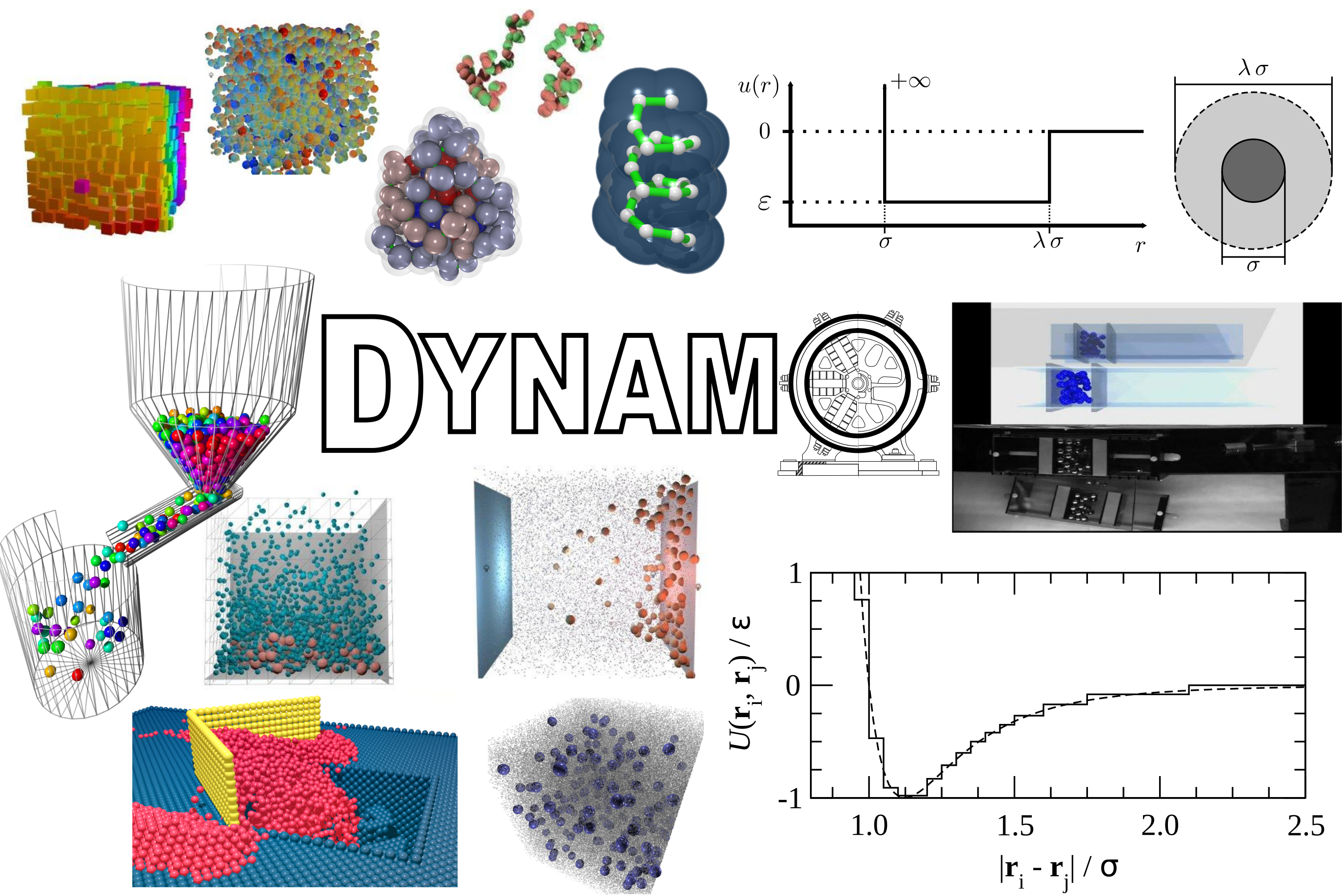
I'm a Chemical Engineer by training, but I started out in my PhD as a scientist. I started my research career writing some modelling software (DynamOMD.com). I was “only” a scientist as these simulations were not directly a real object, but some test of the theories of them (think ideal gas theory and beyond).
-
Then, while working in Germany in my post-doc, I had to simulate real
granular-dampers, and even got to run experiments in
micro-gravity (2009-2011).
I'm the guy sitting on the roof at the back of the plane, my simulation is in the top right, and the bottom right is the high-speed video of an experiment.
- I then started running some of the largest “experiments” possible: designing and running pilot-scale trials producing $\approx 1$ tonne of novel sulfur-based cement as part of the Green Concrete Project (£3.3M, GORD, 2012-16) even until 2025 in other grants.
- I'm still working in this area developing process models for kilns, trying to improve the environmental impact of the cement industry. This is all applied heat, mass, and momentum transfer.
- Did you know cement is the largest manufactured product after drinking water? 0.5 tons made per person per year. $\approx5\%$ of manmade CO2 emissions.
- I (and my collaborators) developed design equations that let me understand how to run a pilot-scale kiln. We also used a lot of lab experiments to understand what we didn't understand.
- We also built Accoustic tractor beams as part of my UG level 4 projects (2017-current). It can silently levitate (and move!) particles, droplets, bugs, using ultrasound.
- Again, HMMT/Transport Phenomena is at the heart of this.
- From 2021-2024, we completed a project with a Aberdeen engineering firm GDi, to take laser scans of offshore process assets and automatically recognise equipment.
- AI, mechanical engineering, Chemical/Process engineering, and the real world!
- The whole company is about rapid engineering through scans of existing platforms. Aims to be the "Amazon prime" of offshore piping.
- Two former PhD students and one former project student now work there.
Rocketry Society
- In 2024, I joined the rocketry society and with Andrew Wilson (MEng Mech. Elec.) built a rocket engine.
- We entered into Race 2 Space, and this is the test firing, from Dec 2024 till July 2025.
- "What we do" talk and intro to the small rocket workshop, Thursday 25 Sep 17:00-18:30, Meston M204.
What is engineering?
Scientists discover the world that exists; engineers create the world that never was. - Theodore Von Karman
Approximation 1: Engineers make things to make money.
Approximation 2: Good engineers need to make things that work, because the things are then valuable and can be sold.
Approximation 3: Great engineers need to be certain that what they make will work as expected/is reliable. Certainty is only available in the world of mathematics, not in the real world so engineers must translate the world into mathematics. This skill makes the engineer and their work valuable.
Approximation 4: An excellent engineer translates
approximates the part of the world they are remaking with
mathematics, so that they can perform
design calculations. These balance the quality of the
design against the available budget and time (and time is money).
They will use iteration when its cheaper to build and test instead
of design, which allows them to use science to explore the
flaws/error in their approximations; however, to make use of this
feedback they must understand the limitations of their mathematics
and their design.
Why Heat, Mass, and Momentum?
- They are conserved quantities. Their amount in one location can only change if they flow/convect and/or conduct/diffuse.
- It turns out the transport phenomena of any conserved quantities is analogous.
Fluid flows conserve mass and momentum
Check out the merging branch, note the flow accelerates after the flows join.
People are conserved over short enough times
See how the flow accelerates after the convergence!
- If you can learn transport phenomena then you can understand the transport of nearly any conserved quantity.
- Almost every engineering system centers around the transport of momentum, heat, and mass.
- These systems may utilise one or all of these modes of transport to achieve a desired effect.
- For example, nuclear reactors need effective heat transport to cool and extract energy from the fission reaction.
- But understanding the heat transfer will also require understanding the mass transfer of coolant, resulting from a transport of momentum.
- Mass can also transfer via diffusion through the walls, but we'd be designing to minimise this particular transport.
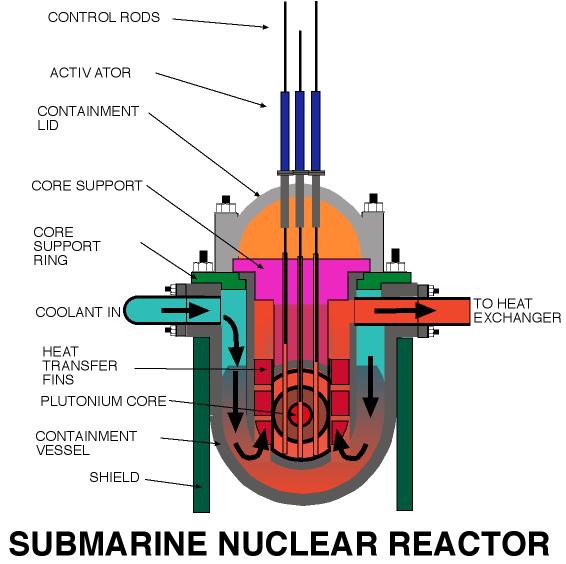
- To perform our jobs as Engineers, we need to be able generate equations that describe all of the modes of any relevant system.
- We need to be able to generate analytical or semi-empirical expressions (design equations) that tell use how the system will behave.
- For example, we need to know how high the driving pressure drop must be to cool the nuclear reactor as a function of reactor dimensions.
- We need to know how the thickness of the containment walls will affect (slow) the heat transfer.
Translating the world into mathematics
- Hopefully, you will now believe me when I say, an Engineer is someone who translates the world into mathematics, then solves it.
-
We actually do this informally all the time:
- Q: Can I buy Goat Simulator 3?
- A: Is your bank balance > £27.
- Q: How long will it take to drive to Edinburgh which is 128 miles away?
- A: Assuming we drive at $60~\text{MPH}$, it will take $S/V=128/60\approx2~\text{h}$.
- The essence of good engineering is choosing the right approximations, making sure you overdesign and not underdesign, i.e., don't choose $70~\text{MPH}$, low-ball your velocity estimate to make sure you're early. Or budget for basic living expenses first.
- Design is never-ending, you can always improve it (i.e., account for traffic, weather, etc.).
- You will need experience to help you decide what are acceptable approximations.
- Many models/approximations start off algebraic like above but as you add complexity they become differential. This course gives you experience in solving differential types of systems.
- Q: A skydiver has lept from a plane, what is their terminal velocity and how do they approach it?
- If gravity is the only thing we consider, then $a=\dot{v}=\ddot{r}=-g$ which we can integrate (twice) to $r = r_0 + v_0\,t -g\,t^2/2$ (SUVAT equation).
- A better estimate includes drag forces which are of the form $F^{drag}=k\,v^2$ where $k$ is a drag coefficient.
- Again we start with our basic differential equation, \begin{align*} F = m\,a = m\frac{{\rm d} v}{{\rm d} t} = F^{gravity}+F^{drag}\\ \frac{1}{g+\frac{k}{m}\,v^2}\frac{{\rm d} v}{{\rm d} t} = 1\\ v = \sqrt{g\,m\,k^{-1}}\tanh\left(t\sqrt{g\,k\,m^{-1}}\right)=\sqrt{g\,m\,k^{-1}}\frac{1-e^{-2\,t\sqrt{g\,k\,m^{-1}}}}{1+e^{-2\,t\sqrt{g\,k\,m^{-1}}}} \end{align*}
- Differential equations are required here (and in most engineering problems) and they will test your math knowledge! Many are unsolvable, including this ballistic motion in 2D has no analytic solution!
- We will take Newton's law, and derive a differential equation for momentum that is more useful for the transport of conserved quantities.
- In this course, we will solve some basic edge cases, where the problems are selected to test only a limited (but non-trivial) range of mathematics. These “basic” problems are actually some of the most important design equations in engineering.
- We'll also look how to solve more generally any problem using numerics.
- You will need to practice the covered maths, and future courses (i.e. CFD) will expand on this!
What should you already know?
- You should already be familiar of some of the simple ways in which we can treat transport phenomena from your earlier courses.
- For conduction of heat, we use the integral form of Fourier's law. \begin{align*} Q &= U\,A\,\Delta T\end{align*}
- The problem with this expression is its only valid for very simple systems (like a flat wall).
- However, as its name suggests, it is the integrated form of differential form of Fourier's law. \begin{align*} q &= -k\frac{dT}{dx}\end{align*}
- We should be able to take the more general differential form and apply it to any heat transfer problem...
- We also need to approach heat transfer problems through Energy balances. \begin{align*} (Q_{in} - Q_{out})\Delta t &= m\,C_P\Delta T\end{align*}
- Again, this is just an integrated form of a differential energy balance: \begin{align*} q_{in} - q_{out} &= \rho\,C_P \frac{dT}{dt}\end{align*}
- Transport phenomena is the study of using differential constitutive relationships (e.g., Fourier's law) and differential balances to generate engineering expressions for any system.
- It's important to note that transport phenomena is more general than heat transfer.
- You should be familiar with the transport equations of basic fluid flow.
- For example, Bernoulli's equation is an energy balance of a flow: \begin{align*}\frac{1}{2}\rho\,v^2 + p - \rho\,g\,h\end{align*} \begin{align*}E_{kinetic} + E_{pressure} + E_\text{grav. potential}\end{align*}
- And there is the Hagen-Poiseuille equation for flow in a pipe, relating the volumetric flow-rate, $\dot{V}$, to the pressure drop, $\Delta p$. \begin{align*} \dot{V}_z= -\pi\frac{\Delta p}{L}\frac{R^4}{8\,\mu} \end{align*}
- Later in the course, we will show that Bernoulli's equation can be derived from a more general momentum balance equation: \begin{align*} \frac{\partial \boldsymbol{v}}{\partial t} &= -\boldsymbol{v}\cdot\nabla \boldsymbol{v} + \rho^{-1}\nabla\cdot\boldsymbol{\tau} - \rho^{-1}\nabla p + \boldsymbol{g} \end{align*}
- If we then use a constitutive relation for momentum, such as Newton's law of viscosity: \begin{align*} \tau_{xy} = -\mu \frac{\partial v_x}{\partial y} \end{align*} we can then derive the Hagen-Poiseuille expression for flow in pipes.
- Again, we can combine a constitutive relationship (Newton's law of viscosity) with a differential balance (momentum balance) to solve flow problems using the study of Transport Phenomena.
Analytical results of Transport Phenomena are usually limited to simple geometries and problems:
As engineers, we'll use simple analytical results as design equations, and lean on numerics/CFD for more complex questions.
-
Boiling liquids are an example of a complex heat transfer and
multiphase flow problems:
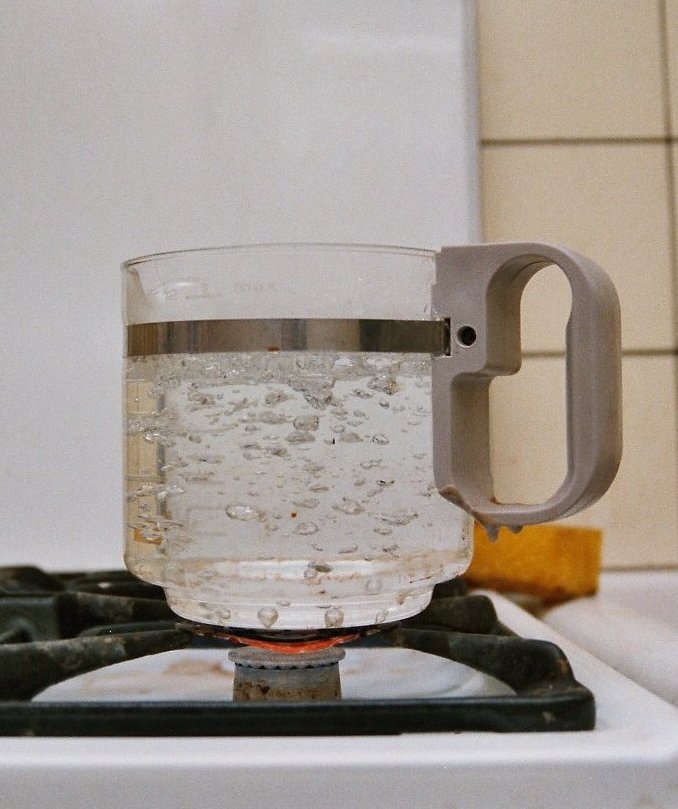
- We will need empirical expressions to be able to perform engineering calculations on this system.
- However, the best empirical expressions are usually based somehow on the simpler analytical results.
- In this course we will look at both analytical results from Transport Phenomena, and empirical “fudges” for more complex systems.
Course Organisation
Lecture schedule (see MyTimetable):
- Three lectures per week.
- One tutorial session per week.
- Weekly online test (30% of final mark) released Monday 8am, due following Monday 8am (except for the final week where its due Friday). Covers the previous week's lecture content. The content tested is made clear on the front of the test. One attempt allowed, timed (1 hour), variable number of questions but should be solvable within 30 minutes or less if you understand everything.
- One three-hour final exam (all questions compulsory).
- Note: EX3030 exams ARE the past exams for EM4012! EM40JN is the old 10-credit course.
Tutorial format:
-
The tutorial questions are made from class examples and past
exam questions. The book of
questions and
solutions are in the menu.
- 60+ questions, 100+ pages (with solutions)
- Only a small number of questions are recommended for you to attempt each week, the rest are additional practice/past exam questions/examples of particular applications for you to review.
- Regularly attempt the questions without solutions. Don't fool yourself about your own understanding.
- Tutorial sessions are there for support. They are useless if you don't participate.
- Attempt to solve the assigned questions in advance, then come and ask about what you didn't understand. Feel free to help each other, we're in this together!
- Attendance monitoring done through the weekly test AND tutorial attendance.
Weekly test
- Random selection (and generation) of questions, some multiple-choice, some numeric.
- One hour time-limit to complete the tests. Save your answers regularly.
- Only one attempt is allowed.
- Solutions for the test are not available.
Support
-
All communication will be provided through MyAberdeen:
- Course announcements, lecture slides, room changes, and coursework submission.
-
In case of problems the primary contact for the course is me:
Dr. M. N. Campbell Bannerman
Room 266, Fraser Nobel Building
Email: [email protected]
Tel: 01224 274480
Course text books
-
R. B. Bird, W. E. Stewart, E. N. Lightfoot, “Transport
Phenomena”
The cheap international paperback version is fine, but the library has lots of copies so you don't have to buy it. There's also a new “Introductory” version but its very expensive. -
Coulson and Richardson's Chemical Engineering:
-
Volume 1, “Fluid Flow, Heat Transfer and Mass
Transfer.”
Available Online. Mainly covers the results of this course and its applications.
-
Volume 1, “Fluid Flow, Heat Transfer and Mass
Transfer.”
-
C. J. Geankoplis, “Transport processes and unit
operations”
Leads nicely onto the follow-on course, separation processes 1.
Learning outcomes
- To understand the structure of the course and its requirements.
- To know that this course requires sustained effort and practice to grasp it.
- To understand that the study of Transport Phenomena is a combination of differential balance equations and differential constitutive relationships.
- You will need to revise your vector mathematics, calculus, and heat transfer knowledge.